The dew point in a roof is the temperature at which water vapor in the air begins to condense inside the roof assembly. If condensation occurs in the thermal insulation or on wooden components, it can lead to moisture buildup, mold, heat loss, and structural damage.
In practice, this means that even a well-constructed roof can become damp if the layering, insulation, vapor barrier, and ventilation have not been properly designed. The consequences include a loss of insulation performance, mold growth, reduced comfort in the building, and gradual structural degradation. This topic is particularly important for developers, designers, and anyone planning to build or renovate a roof who wants to avoid mistakes that lead to condensation. In the following sections, we explain where the dew point in a roof originates, where the problem most often occurs, how the roof assembly layers affect it, how to recognize moisture, and what to check before insulating or renovating a roof.
In this post, you’ll learn about the most common problems:
The “Roofs in Practice” series is a technical compendium of knowledge on the construction and maintenance of metal roofs. The articles cover a wide range of topics—from solid structural foundations, through the physics of materials and moisture management, to informed decisions regarding aesthetics and quality. The series organizes knowledge about how a roof really works: why the roof framing determines the durability of the roofing, how sheet metal reacts to temperature changes, and where condensation comes from. A key element is understanding materials—the guide teaches readers to distinguish between nonwoven fabric and membranes, interpret laboratory test results, and make informed assessments of structural solutions, such as a roof without eaves. Together, this forms a guide that enables you to build and renovate a roof based on technical knowledge, proven materials, and informed choices at every stage of the project.
In this article, you’ll learn what the dew point in a roof is and why it’s so important for the durability of the roof structure. We explain when water vapor begins to condense, how air humidity and temperature differences affect condensation, and why moisture in the insulation can lead to heat loss, mold growth, and the degradation of structural components. You’ll also learn where the risk of condensation is most common in a roof, what role vapor barriers, Thermal insulation, roof membranes, and roof ventilation, and what to check before insulating or renovating a roof to minimize the risk of a dew point forming inside the roof assembly.
The dew point is the temperature at which the air becomes saturated with moisture and water vapor begins to condense. When the temperature drops below this value, the relative humidity reaches 100%, and water vapor turns into water droplets.
In buildings, this means one thing: if a layer with a temperature below the dew point forms in the roof structure, condensation begins.
In practice:
If this phenomenon occurs in the insulation layer or on wooden structural elements, it leads to moisture penetration and a deterioration in their performance characteristics.
The source of moisture isn’t just the weather outside. The interior of the building has the greatest impact.
Water vapor in the air is produced during everyday activities:
Water vapor penetrates building envelopes in the form of invisible moisture, and if the vapor barrier is leaky, it can seep into the roof layers in greater quantities. Even a well-installed vapor barrier does not completely eliminate this phenomenon—its primary purpose is to limit the amount of water vapor penetrating the roof structure.
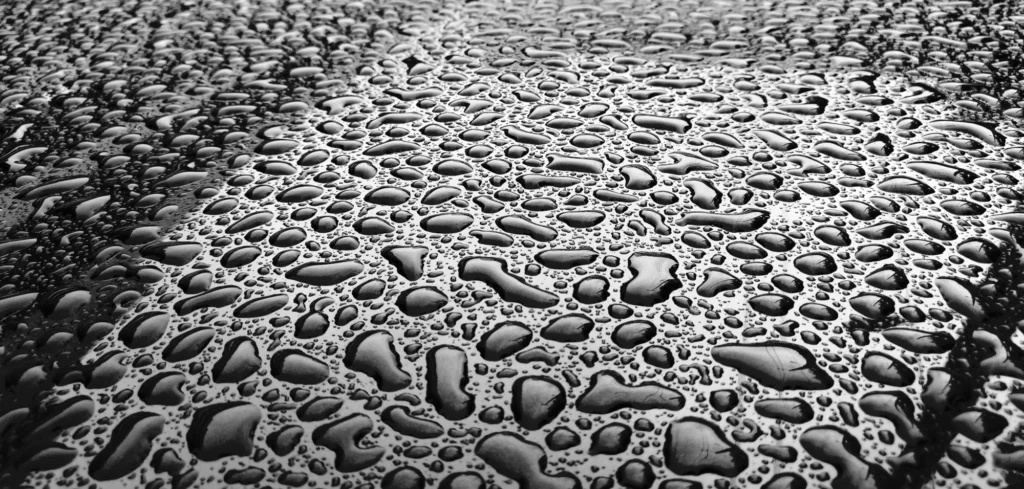
Condensation does not occur randomly. It most often appears in areas where thermal bridges are present and at the joints between different roof components.
Typical risk areas:
If a condensation zone associated with the dew point forms in the mineral wool layer or near the wood, this can lead to temporary or permanent moisture buildup. As a result, the mineral wool loses its insulating properties, and the wood begins to expand and contract under conditions of elevated humidity.
Each layer of the roof affects where the dew point will be:
The better the materials, layer configuration, and insulation thickness are selected, the easier it is to reduce the risk of dew forming inside the building envelope. It is not only the thickness of the insulation that matters, but also the thermal transmittance coefficient, the airtightness of the vapor barrier, and proper roof ventilation.
A well-designed layer system helps maintain a favorable temperature distribution in the roof, reduces water vapor condensation, and protects insulation materials, such as mineral wool, from moisture. This is important because moisture in the insulation impairs its performance and can lead to the gradual degradation of structural components.
In modern roofing systems, the layers should form a cohesive system that facilitates moisture control and reduces the risk of condensation. Insulation, a vapor barrier, a roof membrane, and effective roof ventilation are all important factors here.
The risk of water vapor condensation in the roof can be reduced as early as the design and construction stages of the roof structure. Airtightness, proper thermal insulation, and effective roof ventilation are of key importance.
To reduce the risk of dew forming inside the roof cavity, it’s important to consider a few factors:
Insufficient insulation thickness causes the temperature in the wall cavity to drop more quickly, which increases the risk of reaching the dew point and causing condensation.
A leaky vapor barrier allows moist air from inside the building to penetrate the insulation.
Structural elements that reach ambient temperature faster than the insulation cause localized temperature drops.
A lack of continuity or improper installation of the membrane disrupts moisture transport.
Dew point analysis is sometimes overlooked during the design phase, which can lead to errors that only become apparent years later. In more complex cases, it is advisable to perform a thermal and humidity analysis of the building envelope.
The first signs of condensation aren’t always visible right away. The process begins on a microscopic scale—inside the roof cavity—before any water appears on the surface.
It is crucial to understand that this occurs when the air in the cavity becomes saturated and its relative humidity reaches 100%. At that point, water vapor begins to condense into dew—that is, tiny droplets of water.
One of the first signs is a decline in the insulation’s performance.
Symptoms:
In practice, this means that moisture in the wall cavity degrades the performance of the insulation materials, and the structure becomes less effective at retaining heat.
When moisture persists for a long time, it begins to affect the roof structure.
Symptoms:
This is the stage at which moisture begins to have a real impact on the roof structure itself, not just on the insulation layers.
The next stage involves symptoms that are noticeable to the building’s occupants.
Symptoms:
Under such conditions, indoor humidity is elevated, and maintaining thermal comfort becomes more difficult. This situation not only promotes mold growth but also the growth of fungi, which affects the comfort and health of the occupants.
In its advanced stage, the problem becomes visible to the naked eye.
Symptoms:
This is a situation in which temperature differences and a lack of moisture control have led to condensation in the partition.
Several key factors influence the formation of condensation:
The higher the humidity, the higher the dew point and the greater the risk of moisture condensing in the roof.
All of these factors can cause the dew point to occur deeper within the partition, increasing the risk of moisture condensation.
In practice, this means that the problem doesn’t arise suddenly. It’s a process in which:
This situation must be addressed at an early stage, before the insulation becomes permanently damp and the wooden components begin to deteriorate.
Before building or renovating a roof, it’s worth paying attention to a few key factors:
Additionally, it’s worth checking whether the design takes into account the operating conditions of the partition at different temperatures—since the dew point temperature varies with humidity and air temperature. If there are any concerns about humidity levels in the building, it’s a good idea to check the humidity conditions and consult with a designer or specialist regarding the layer configuration.
Dew point in the roof is a phenomenon that cannot be ignored, as it directly affects the structural integrity and comfort of the building. When water vapor begins to condense inside the roof assembly, it leads to the gradual degradation of the insulation and wooden components.
That is precisely why it is so important to combine proper insulation, an airtight vapor barrier, and an efficient ventilation system.
Only then will the roof remain dry, stable, and durable for many years.
No. The dew point is a natural physical phenomenon. The problem arises when water vapor condenses inside the roof assembly, particularly within the thermal insulation layer or near wooden components. If moisture cannot evaporate or be removed through roof ventilation, it can lead to dampness in the insulation, mold growth, and gradual structural degradation.
Symptoms of condensation may include damp mineral wool, dark discoloration of the wood, a musty odor in the attic, mold on the rafters, uneven indoor temperatures, and visible water droplets on the underside of the roofing material or membrane. It is important to investigate these symptoms as soon as possible, because moisture in the roof cavity can degrade the insulation’s performance and affect the structure’s durability.
An airtight vapor barrier significantly reduces the migration of water vapor from inside the building into the roof assembly, but it does not solve the entire problem on its own. Equally important are adequate thermal insulation thickness, the elimination of thermal bridges, proper assembly of the roof membrane, and effective roof ventilation. Only the entire layered system reduces the risk of condensation.
Roof ventilation helps remove moisture from beneath the roof coverings and from the roof layers. If the intake at the eaves or the outlet at the Ridge is blocked, moisture can remain in the roof cavity and increase the risk of condensation. Therefore, the ventilation gap should ensure a continuous flow of air from the eaves to the Ridge.
A thermal and moisture analysis is recommended for roofs with an atypical layer configuration, during the renovation of an old attic, when converting an attic into living space, when changing the insulation method, or if moisture problems have occurred in the past. Such an analysis helps assess where the dew point may occur and whether the layer configuration reduces the risk of moisture penetration in the roof structure.
Thermal bridges around the roof are one of the most common issues affecting a building’s energy […]
Read moreYes, the roof can visually alter the proportions of a house—and often does so more significantly […]
Read moreCondensation under a metal roof is a phenomenon that should not be overlooked. Water vapor condensation […]
Read moreChoosing a roof covering is one of the most important investment decisions, as it affects the […]
Read moreUntil recently, a “cube house” from the communist era was associated with architectural mediocrity. Today, it […]
Read more