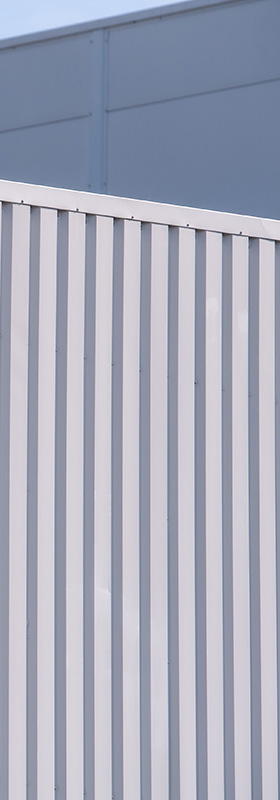
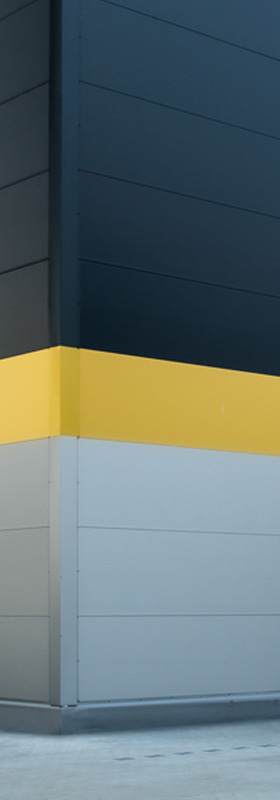
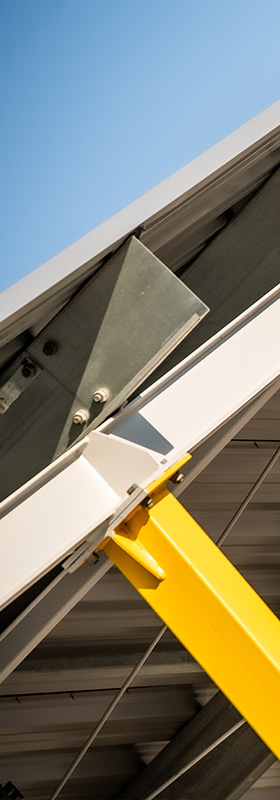
Today, it is difficult to imagine construction—particularly public, industrial, and agricultural buildings (storage facilities, cold storage, freezer rooms, and livestock housing) without building envelopes (Curtain walls, roofs) made of sandwich panels, particularly those with metal cladding.
Lightweight sandwich panels are structures composed of rationally selected and appropriately bonded structural and insulating-structural materials. They consist of outer claddings with high mechanical properties that are continuously bonded to a core layer with negligible flexural stiffness but favorable thermal insulation properties.
In addition to curtain walls and roofing, sandwich panels are used as:
The most common core materials on the market are so-called PIR foam (polyisocyanurate) and mineral wool, which are steadily replacing the expanded polystyrene (EPS) core that was once popular. Both PIR and mineral wool have their advantages and are designed for different applications. Currently, PIR foam panels—such as our entire PIRTECH product line—enjoy the greatest popularity on the market, among both developers and architects.
The wide range of applications for sandwich panels stems from their advantages, which include, among others:
Our product range essentially includes two types of PIRTECH panels based on their application: PIRTECH wall sandwich panels and PIRTECH roof sandwich panels. Both variants feature a core of cured PIR foam sandwiched between coated steel cladding, though they differ in thickness and in the profiling of the outer claddings.
Wall panels with a maximum modular width of 1,150 mm (exposed fasteners – ST, CH) and 1,050 mm (concealed fasteners – PL), as well as roof panels (PWD) allow for simple and quick assembly on various types of structures using appropriate through-fasteners. Uniquely designed tongue-and-groove longitudinal joints ensure excellent airtightness, fire resistance, and quick assembly. Currently, the Blachy Pruszyński Company offers four basic variants of PIRTECH panels, a product with a similar core but different claddings and intended use (strictly for insulation). It is worth noting that thanks to continuous modernization and investments, our products meet stringent standards, and following the launch of a new production line for wool-core panels—WOOLTECH— all are compatible with one another during assembly and can be freely combined during design or assembly.
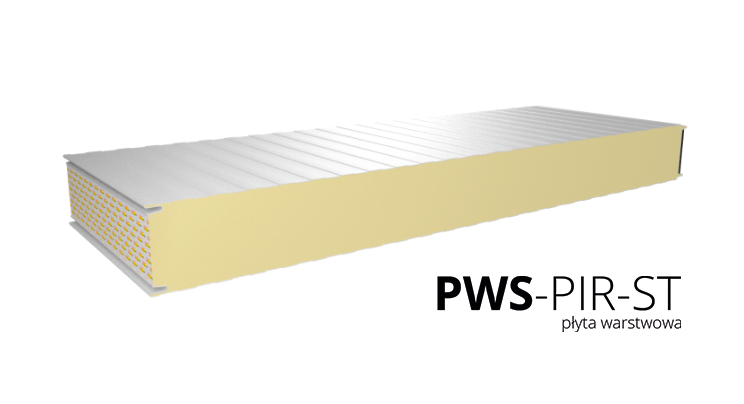
PIRTECH STANDARD wall sandwich panels with a polyurethane foam core (visible fasteners) with a maximum modular width of 1,150 mm allow for quick and easy assembly on various types of structures using appropriate through-fasteners. Uniquely designed tongue-and-groove longitudinal joints ensure excellent airtightness, fire resistance, and quick assembly.
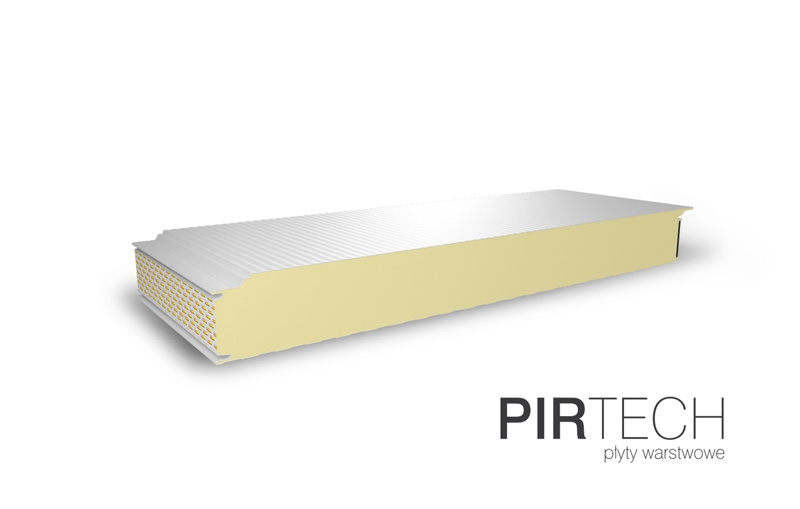
PIRTECH Ściana PLUS wall sandwich panels with a polyurethane foam core (concealed fastening) and a maximum modular width of 1,050 mm allow for quick and easy assembly on various types of structures using appropriate through-fasteners.
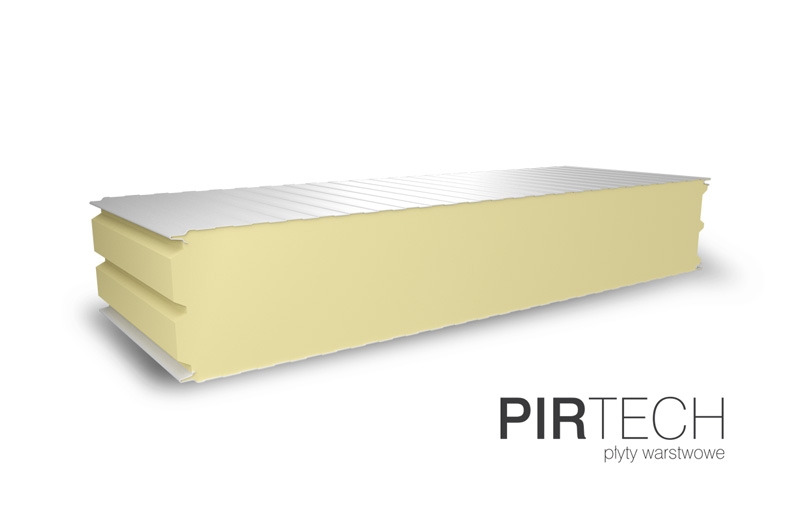
PIRTECH PIR-Core Wall Sandwich Panels for COOLING WALLS with a polyurethane foam core (visible fasteners) with a maximum modular width of 1150 mm allow for quick and easy assembly on various types of structures using appropriate through-fasteners.
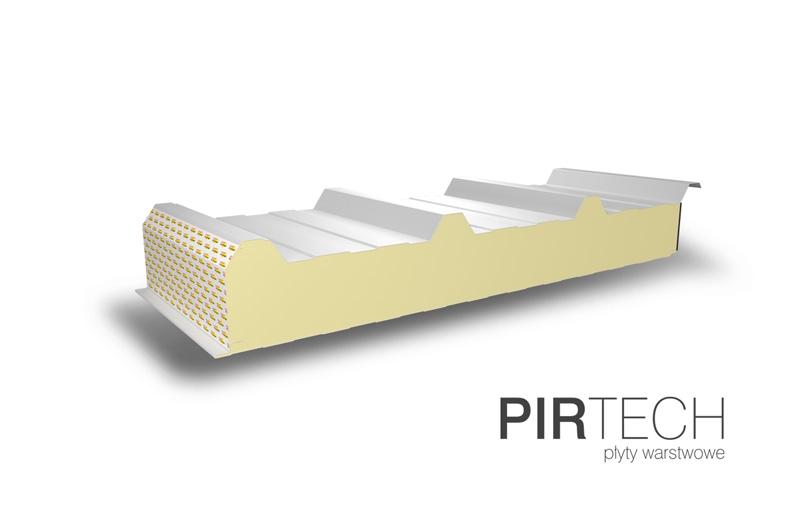
PIRTECH Roof Sandwich Panels with a polyurethane foam core (visible fasteners). In addition to curtain walls, sandwich panels are also most commonly used as roof coverings. They ensure relatively simple and automated assembly within the system, which significantly speeds up the construction process. Due to the completely different stresses and loads to which roof sandwich panels are subjected, the outer metal cladding typically has a trapezoidal profile with a large rib height, ensuring the appropriate stiffness required for a roof. Note: The panel is available only in widths up to 1050 mm.
The PIRTECH-type rigid polyurethane foam core sandwich panel system with metal cladding manufactured by the Blachy Pruszyński Company includes:
PROFILE > |  PIRTECH STANDARD |  PIRTECH PLUS |  PIRTECH COLD STORAGE | 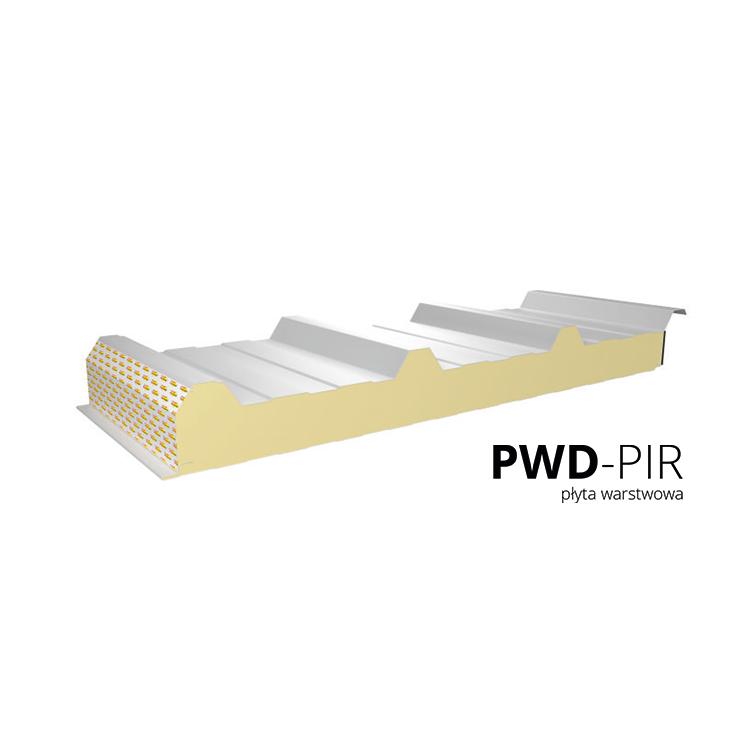 PIRTECH ROOF |
label | PWS-PIR-ST | PWS-PIR-PL | PWS-PIR-CH | PWD-PIR |
core | Polyurethane – PIR | |||
profile height | 40, 50, 60, 80, 100,110, 120 mm | 60, 80, 100, 120 mm | 120, 140, 160, 180, 200, 220 mm | 40, 60, 80, 100, 120, 160 mm |
effective width | 1150 mm | 1050 mm | 1150 mm | 1050 mm |
sheet thickness | 0,5 – 0,7 mm | |||
recommended minimum roof slope | n.a. | 5% (3 º) * for continuous panels, without skylights | ||
recommended roof slope ** | n.a. | 7% (4 º) **for transversely lapped panels or skylights | ||
external profiling | trapezoid – T micro-trapezoid – M wave – F | trapezoid – T40mm | ||
internal profiling | trapezoid – T | |||
protective coatings | polyester gloss/matt, polyurethane, HPS200, aluzinc | |||
Wall sandwich panels are a construction product used for wall cladding on buildings such as production halls, warehouses, or other commercial and service facilities. Although their main application is industrial and commercial investments, this does not exclude their use by individual clients, provided they meet the project requirements. An important aspect is that sandwich panels are cladding products, not load-bearing ones. This means they are mounted to load-bearing structural elements, thus forming walls.
The key structural feature of sandwich panels is the combination of metal cladding with a core characterized by distinct thermal or acoustic insulation, which also references their English name: “sandwich panels”. In the case of the PIRTECH line, our customers can choose from three different categories of PIRTECH panels. The basic variant is the PIRTECH ST panel, which is the base wall panel option with a visible joint. The next one is PIRTECH PL, which is a wall panel with a so-called hidden joint, where the panel connections and screws are concealed under a specially profiled cover at the joint. The final variant available to our customers is the cold storage panel, namely PIRTECH COLD STORAGE. This is a product of increased thickness with a visible joint, designed for specialized applications in buildings where maximum thermal insulation is of particular importance—such as industrial cold storage facilities, from which this variant takes its name.
In addition to curtain walls, sandwich panels are also most commonly used as roof coverings. This application of the product has significant advantages. One of the fundamental ones is the reduction of heat loss in the building, thanks to the high thermal insulation of the sandwich panels. Additionally, they ensure relatively simple and automated assembly within the system, which significantly speeds up the building construction process. As in the case of wall panels, the principle of roof panels is the same: metal cladding is joined together by a core providing high thermal insulation parameters. The main difference between wall and roof panels is the different profiling of the outer cladding. Due to completely different stresses and loads to which roof sandwich panels are subjected, the external metal cladding usually has a high-pitch trapezoidal profile, ensuring the appropriate rigidity required on the roof.
The Blachy Pruszyński offer includes roof sandwich panels with a polyurethane foam core marked with the symbol PWD-PIR, which have thermodynamic characteristics very similar to wall panels.