Every material reacts to temperature, changing its dimensions to a greater or lesser extent. The phenomenon of thermal expansion in roofing metal sheets is therefore a natural consequence of their physical properties and an inherent part of the roof’s operation. And since the roofing is subject to constant deformation, the structure, the fastening of the sheet metal, and the assembly method must allow for the safe compensation of these changes—only then can the long-term durability of the entire system be ensured.
In this post, you’ll learn about the most common problems:
The “Roofs in Practice” series is a technical compendium of knowledge on the construction and maintenance of metal roofs. The articles cover a wide range of topics—from solid structural foundations, through the physics of materials and moisture management, to informed decisions regarding aesthetics and quality. The series organizes knowledge about how a roof really works: why the roof framing determines the durability of the roofing, how sheet metal reacts to temperature changes, and where condensation comes from. A key element is understanding materials—the guide teaches readers to distinguish between nonwoven fabric and membranes, interpret laboratory test results, and make informed assessments of structural solutions, such as a roof without eaves. Together, this forms a guide that enables you to build and renovate a roof based on technical knowledge, proven materials, and informed choices at every stage of the project.
In this article, you’ll learn what thermal expansion of roofing metal sheets is and why it’s said that a roof made of roofing metal sheets “moves.” Temperature changes cause the sheets to naturally expand and contract, and this phenomenon occurs in every steel roofing system—regardless of the profile type or manufacturer. It’s important to understand how metal roofing “moves,” why proper assembly must allow for stress compensation, and what consequences assembly errors—such as over-tightening screws or restricting panel movement—can have. You’ll also learn when noises from the metal roofing are a natural occurrence and when they may indicate problems with the roof’s structure or assembly.
The term “expansion” of a roof refers to the cyclical changes in the dimensions of the metal roofing caused by temperature fluctuations. This means that the metal sheets expand as the temperature rises and contract as it drops. This phenomenon repeats itself in successive daily and seasonal cycles, and its magnitude depends , among other things, on the number of temperature change cycles and the maximum temperature differences between summer and winter, as well as between nighttime and a day heated by the sun.
These movements occur across the entire surface of the roofing and must be taken into account during assembly. In the case of profiled metal sheets, the way they are laid is particularly important, as the geometry of the profile and the length of the sheets contribute to linear displacement caused by temperature changes. Improper fastening of the roofing metal sheets restricts their ability to move freely, which leads to the development of stresses in the roof coverings and shortens the roofing system’s service life.
Expansion is a physical property of materials characterized by changes in their dimensions under the influence of temperature. As already mentioned, as the temperature rises, sheet metal expands, and as it falls, it contracts. The individual changes are minor—these are seemingly small elongations that, taken individually, are of limited significance. What is significant, however, is the cumulative displacement resulting from seasonal temperature fluctuations and the frequent daily variations occurring within the roof coverings. With long metal sheets and a significant range of daily temperature variations, this leads to recurring linear deformations, which depend on the initial length of the building component. This applies to both steel and aluminum—with the latter expanding more than twice as fast, which is of great importance when selecting a fastening and expansion joint system.
For this reason, the design of roofing systems must account for permissible movements by appropriately dividing the sheets, incorporating expansion joints, and using proper fastening solutions that allow for the compensation of expansion without generating stresses within the roof.
The use of smaller roofing sections, proper segmentation, and short sections of curves in the installation ensures that the system withstands temperature changes better and operates in a more controlled manner. It is essential to follow these principles for every roof, regardless of the type of roofing material or the length of the roof surface.
Changes in the dimensions of metal result from its crystalline structure. At elevated temperatures, thermal energy causes the atoms in the steel’s crystal lattice to vibrate more intensely, which increases the average distances between them. On a macroscopic scale, this results in the element expanding. As the temperature drops, the amplitude of the vibrations decreases and the distances between atoms shrink, causing the materials to contract; this applies to both steel and aluminum.
In the case of roofing metal sheets, it is important to note that the metal does not heat up evenly across its entire surface. On a sunny day, the surface temperature of the metal can vary by as much as several dozen degrees—dark coatings can reach as high as 80–90°C, while light-colored ones reach about 50–60°C—depending on the angle of sunlight, the color of the coating, and ventilation conditions beneath the roofing. The intensity of the roofing system’s operation is influenced by the maximum temperature reached. This results in significant temperature differences between individual zones of the roof surface (including one side of the roof), leading to uneven deformations and additional movement of the sheets.
As a result, over the course of daily and seasonal cycles, the metal roofing is constantly subjected to small but recurring dimensional changes resulting from the number of temperature cycles. In the long term, it is the cumulative effect of these cycles that determines the load on the fastening system and the durability of the roof coverings.
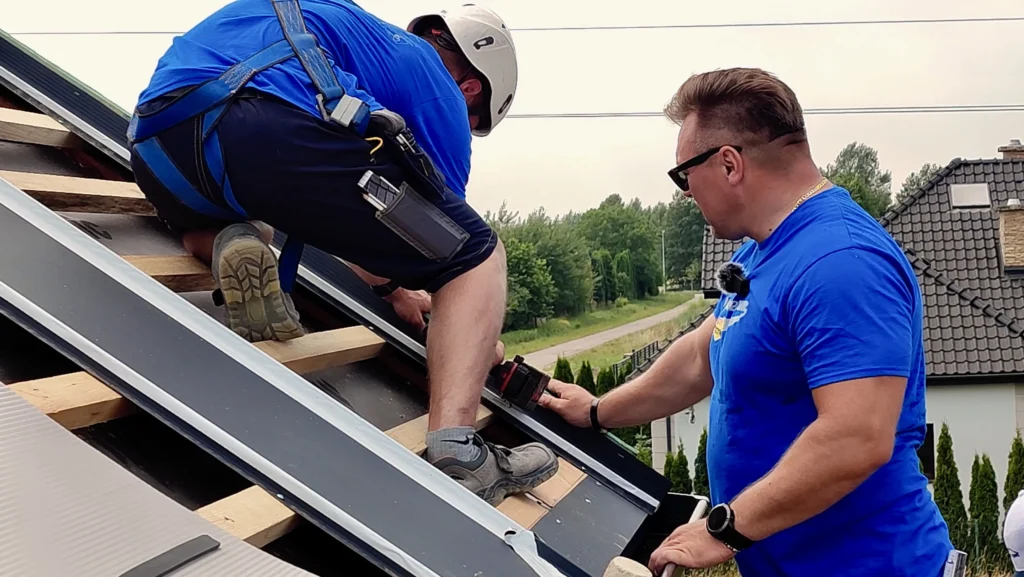
Restricting the material’s natural movement leads to the buildup of stress around fasteners and roof components. This can result indeformations, surface waviness, and even damage to protective coatings.
In extreme cases, the roof covering may become compromised, particularly in areas such as chimney flashings or roof penetrations. Improper installation of metal flashings further increases the risk of leaks.
Restricted expansion can also lead to damage to certain fastening points, where stresses accumulate due to the inability of the sheet metal to move freely, as well as to deformation of the substrate (e.g., battens or counter-battens), which negatively affects the durability of the entire roofing system.
In panel systems, proper panel fastening and the quality of the screws and sealing strips used in the joints are of critical importance. Screws should be tightened to the correct torque—while maintaining a minimum amount of play to allow for thermal movement. In practice, this means controlled pressure, in which the washer/sealing strip (most often EPDM) is compressed but not deformed to the point of losing its elastic properties. It is the sealing strips that determine the long-term tightness of the connection—over-compressing them reduces sealing effectiveness and shortens the system’s service life. A properly installed fastening allows for slight flexibility in the contact area—the panel is not “clamped rigidly” but can move relative to the fastening point within the range of micro-movements caused by temperature changes. Verification involves a visual and installation inspection: the washer should be pressed down evenly, with no visible material oozing beyond the screw’s diameter and no “indentation” suggesting excessive pressure.
Tightening the fasteners too much prevents the sheets from moving freely. As a result, stress concentrates around the sheet metal fastening points, which can cause the joints to lose their seal. In addition, the sealing strips determine the tightness of the joint—compressing them excessively reduces their sealing effectiveness.
The most common mistakes include:
It is also important to limit the length of individual sheets appropriately and divide them into shorter sections, which allows for better compensation for temperature changes. In practice, the roofing layout should comply with the manufacturer’s recommendations and be adapted to the range of temperature changes and the geometry of the roof surface. The use of segmentation and short sections of bends helps limit the accumulation of deformations and improves the roofing system’s ability to function under variable thermal conditions. This also applies to elements made from a single strip of sheet metal, etc., which are more susceptible to thermal deformation when excessively long.
No. The sounds associated with sheet metal are a natural result of the material expanding and contracting. They occur particularly often when the metal heats up suddenly, such as after sunrise.
However, if the noise is intense or occurs irregularly, it is worth examining how the sheets are secured and whether they are able to move freely. The problem may be caused by excessive stress or installation errors.
The quality of materials, proper assembly, and correct execution of flashings are of great importance. The impact of temperature changes on the roofing system must be taken into account as early as the design phase—neglect at this stage directly affects the durability of the entire structure. Attention should be paid to:
Ultimately, the durability of the roof coverings depends on properly accounting for thermal expansion. Even minor installation errors can lead to damage to the roofing system over time.
The thermal expansion of steel sheet is approximately 0.012 mm per meter of length and per degree of temperature change. A 6-meter-long sheet, heated by 60°C (a typical temperature difference between freezing winter conditions and a hot sheet surface in summer), will expand by approximately 4–5 mm. Therefore, sheet metal fastenings must allow for expansion clearance, and the maximum sheet lengths should comply with the manufacturer’s recommendations.
The sounds coming from the metal roofing are a natural result of thermal expansion—metal sheets expand when heated and contract when the temperature drops, causing characteristic cracking sounds, especially on a sunny day or just after sunrise. If the noises are intense or irregular, it’s worth examining how the roofing metal sheets are fastened—this may indicate that they’re secured too rigidly, preventing the roofing elements from expanding and contracting freely.
Flashings, including chimney flashings and roof penetrations, should be inspected at least once a year—preferably in the fall, before the winter season. These areas are most vulnerable to the effects of restricted thermal expansion: stresses accumulating in critical areas can lead to loose joints and leaks. Improper installation of sheet metal flashings significantly increases this risk.
Yes—the thermal expansion coefficient of aluminum is approximately 23 × 10⁻⁶/°C, which is more than twice that of carbon steel (approximately 11–12 × 10⁻⁶/°C). This means that the same metal sheet, given the same length and the same temperature change, will expand more than twice as much if it is made of aluminum. This is very important when selecting a fastening system, determining maximum sheet lengths, and calculating the required expansion joints.
Restricting the free thermal movement of the sheet metal leads to the buildup of stresses in the roofing metal sheets and at the fastening points. This can result in deformation and buckling of the sheet metal surfaces, damage to protective coatings, compromised chimney flashings, and leaks. In the long term, restricted expansion also leads to deformation of the substrate—battens and counter-battens—which negatively affects the durability of the entire roof. The number of temperature cycles throughout the year means that even minor installation errors accumulate and, over time, cause serious damage.

Metal roof tiles are a lightweight and durable roofing material, but their longevity depends largely on […]
Read moreMartens are clever animals that are increasingly taking up residence in the roofs of single-family homes. […]
Read moreProper roof ventilation and careful attention to details—such as the air inlet at the eaves, the […]
Read moreAlthough the pre-covering is not visible, it plays a crucial role in roof construction. Typically, highly […]
Read moreRoof safety is one of the key requirements of any construction project. Compliance with health and […]
Read more