The layers of the roof must protect the building envelope not only from rainwater, but also from water vapor originating from inside the building and from the formation of condensation beneath the roof covering. Therefore, on steep roofs, roof membranes are typically used as a pre-covering, while on metal roofs, an anti-condensation coating is used in certain cases.
In this post, you’ll learn about the most common problems:
The “Roofs in Practice” series is a technical compendium of knowledge on the construction and maintenance of metal roofs. The articles cover a wide range of topics—from solid structural foundations, through the physics of materials and moisture management, to informed decisions regarding aesthetics and quality. The series organizes knowledge about how a roof really works: why the roof framing determines the durability of the roofing, how sheet metal reacts to temperature changes, and where condensation comes from. A key element is understanding materials—the guide teaches readers to distinguish between nonwoven fabric and membranes, interpret laboratory test results, and make informed assessments of structural solutions, such as a roof without eaves. Together, this forms a guide that enables you to build and renovate a roof based on technical knowledge, proven materials, and informed choices at every stage of the project.
In this article, you’ll learn how anti-condensation nonwoven fabric differs from a roof membrane and which solution is right for your roof. Homeowners often treat both materials as interchangeable, yet they serve completely different functions in different types of roof structures. It’s worth understanding how each works within the roof assembly, why anti-condensation fabric cannot replace a roof membrane in an insulated roof—and vice versa—and what mistakes can result from confusing these two solutions. You’ll also learn when sheet metal with an anti-condensation coating is sufficient, and when a full-fledged pre-covering is necessary—and why this choice directly affects the durability of the entire roof.
Anti-condensation nonwoven fabric is a fibrous layer applied at the factory to the underside of the sheet metal. It is made of synthetic fibers, most commonly polyester, forming a structure similar to felt—the purpose of the felt is to reduce water dripping from the sheet metal surface and stabilize humidity in the space beneath the roofing. The nonwoven fabric is permanently bonded to the sheet metal during the manufacturing process (applied before profiling), usually by gluing or spraying during the profiling stage. It is primarily used in trapezoidal sheet metal roofing and in select metal roof tile systems offered by certain manufacturers, such as Blachy Pruszyński Company.
Anti-condensation coatings cover a significant portion of the underside of the sheets, excluding the overlap areas and edges, due to technological limitations and installation requirements. The coating’s parameters, such as thickness and surface weight, are selected to ensure its stability and resistance to damage during transport and assembly. Note: Uncovered sides must be properly shaped and provided with adequate moisture-venting conditions.
Remember! Anti-condensation nonwoven fabric is not a standalone pre-covering—it is a component of the roof coverings and functions solely as part of them.
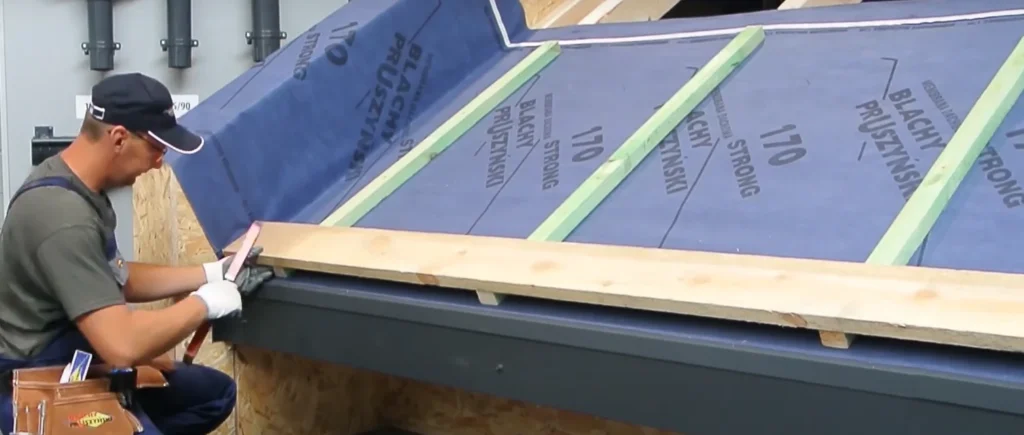
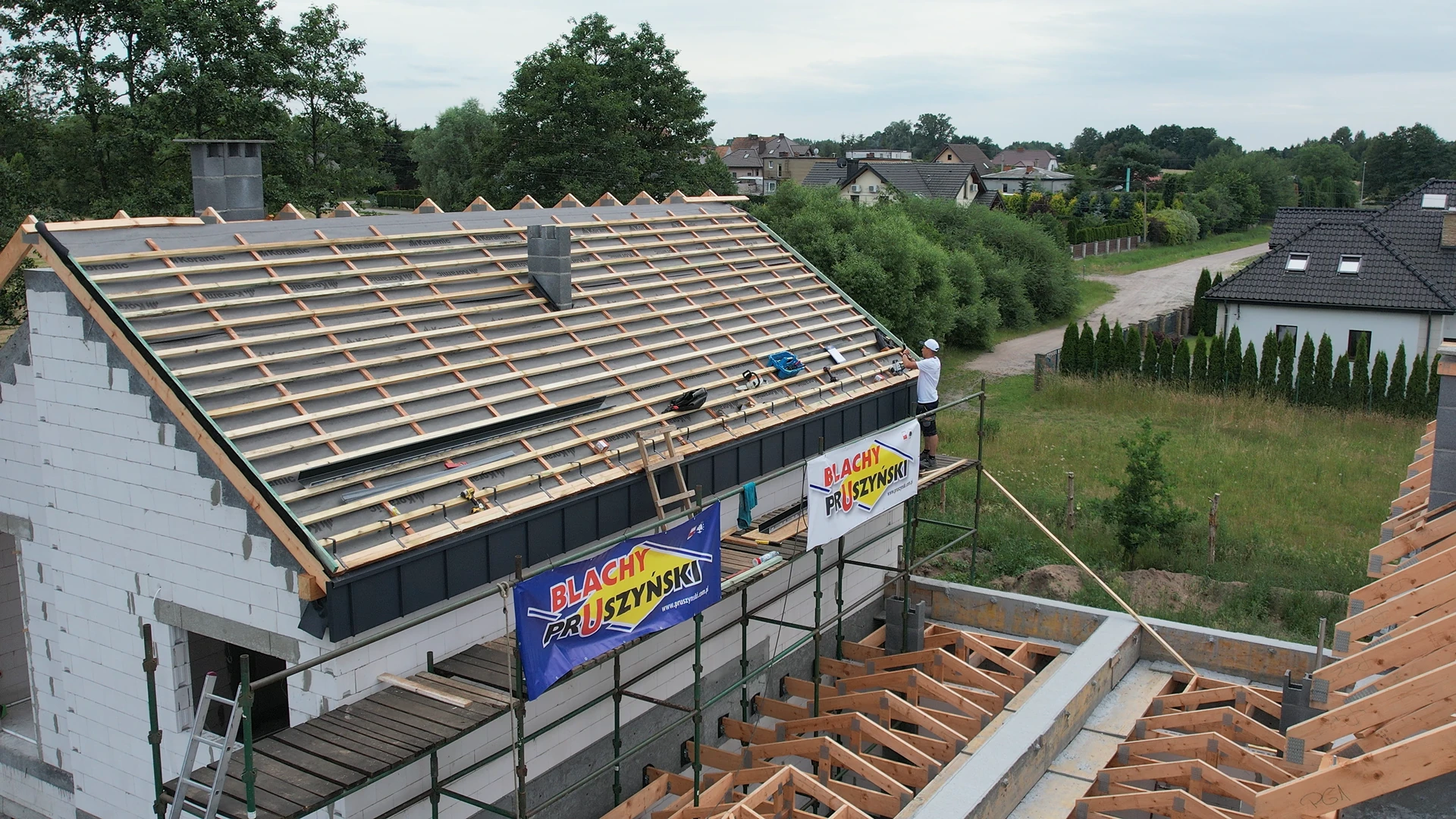
Roof membranes are typically used as pre-covering in steep-slope roofs. They are a multilayer material consisting of a functional core and protective layers. The core, which is a synthetic coating, is responsible for selective permeability—it acts as a barrier to liquid water while allowing water vapor to pass through. The protective layers shield it from external factors such as UV radiation, wind, and mechanical damage.
The membrane’s structure is most often based on polypropylene or polyester nonwovens, which stabilize the layered structure and provide its mechanical strength.
Important! Only a high-quality product is characterized by a uniform structure and consistent technical properties throughout the entire cross-section of the material.
The fundamental difference between a roof membrane and an anti-condensation nonwoven fabric stems from their location within the roof system and their structural function. The membrane serves as a pre-covering for the roof structure, whereas the nonwoven fabric is a component of a metal roofing system and does not form a standalone roofing layer.
Of course, the differences also apply to the materials’ construction. A roof membrane has a multilayer structure—it consists of a functional layer and protective layers, which determine its performance characteristics and protect the structure from external factors. Anti-condensation felt, on the other hand, is a homogeneous layer of synthetic fibers (most often polyester) that are permanently bonded to the metal sheet during the manufacturing process.
The way these two solutions function in the roof cavity is different. A roof membrane serves as a separating layer in the roof system—it protects the structure from rainwater or meltwater that might seep under the roof covering, while allowing water vapor to pass through the barrier. The anti-condensation nonwoven fabric, on the other hand, is bonded directly to the roofing material and forms part of it, limiting the effects of moisture condensation on the underside of the metal sheet.
There are also significant differences in terms of durability and performance. Roof membranes generally offer greater resistance to UV radiation and mechanical damage during assembly, whereas anti-condensation nonwoven fabric is a material protected by the roof covering and functions exclusively within it.
Moisture condensation occurs under trapezoidal sheets, especially when there are large temperature differences between the interior of the building and the outside environment—where cold air flows in—and when the air humidity is high. In turn, the metal sheet cools down quickly, which promotes water vapor condensation.
Under such conditions, the anti-condensation coating—in the form of a fibrous layer permanently bonded to the sheet metal— acts as a moisture buffer. Its function is based on the principle of water vapor absorption. Condensing water vapor is temporarily retained within the nonwoven fabric’s structure (based on the phenomenon of absorption of condensing water vapor), rather than flowing freely down the surface of the sheet metal. The water does not form free droplets but is dispersed throughout the material’s structure. As temperature conditions change and air humidity decreases, the felt gradually releases water into the space beneath the roofing, from where the water runs off or is vented away through ventilation. This solution reduces moisture buildup in the elements beneath the roofing and enhances the structure’s aesthetic appeal, while preventing mold growth and eliminating water dripping from the metal sheet’s surface.
It is important to note that the anti-condensation nonwoven fabric functions exclusively within the metal roofing system and is not a component of the roof layers. Its effectiveness depends on the ventilation conditions in the space beneath the roofing.
Attention! On a roof where rainwater (or meltwater) may come into contact with the anti-condensation felt layer, the felt should be removed or sheet metal without an anti-condensation coating should be used.
A roof membrane serves as a pre-covering layer in pitched roofs and effectively protects the roof structure from rainwater that may seep under the roof covering, and allows moisture that penetrates the roof from inside the building, as well as moisture generated by the materials themselves, to escape.
Installed directly beneath the roof covering , it acts as a barrier against liquid water while remaining permeable to water vapor. As a result, it reduces the risk of condensation forming on the interior side of the roof, stabilizes humidity conditions within the building envelope, and minimizes the risk of condensation.
As a result, the membrane stabilizes moisture conditions in the roof and ensures the safe performance of the roof assembly in insulated systems, where it acts as a moisture control layer.
Although both the roof membranes and the anti-condensation membrane serve a protective function, their roles in the roofing system and their modes of operation differ. Anti-condensation membranes are used in metal roofing systems in uninsulated structures, such as farm buildings, warehouses, or sheds. In such systems (for structural reasons), there is no thermal insulation layer, the material operates within the roofing system and is not directly exposed to intense solar radiation, and a significant operational issue is water vapor condensation on the underside of the metal sheet. In such structures, roof membranes are exposed to adverse operating conditions within the roof assembly, resulting from large temperature fluctuations and high humidity in the space beneath the roofing, and therefore do not fulfill their typical function as a pre-covering layer in these situations.
In contrast, the applications for membranes are entirely different. Membranes are used in insulated roofs, most commonly in residential construction. In such systems, they serve as a pre-covering layer, functioning within a structure that includes Thermal insulation and finishing layers; however, their sensitivity to excessive solar radiation must be taken into account in the event of temporary exposure during assembly.
In practice:
The choice of solution depends on the roof’s layered structure—the presence or absence of thermal insulation—and how the roof system handles moisture.
The most serious mistake is to treat anti-condensation nonwoven fabric as a substitute for a roof membrane, and vice versa. This is due to their different positions in the roof system—the membrane serves as the pre-covering for the roof structure, while the nonwoven fabric is a component of the metal roofing system.
Using nonwoven fabric instead of a membrane in an insulated roof results in the absence of a proper pre-covering, which disrupts the performance of the roof system and can lead to moisture penetration into the insulation layers. Conversely, using a membrane instead of a nonwoven fabric underlayment (e.g., in buildings with trapezoidal sheets without insulation) eliminates the function of limiting condensation on the underside of the sheets, resulting in unchecked moisture condensation.
It is also a mistake to assume that both materials serve the same function in a roof—in fact, they differ in their position within the layered structure and in their scope of function within the roof assembly.
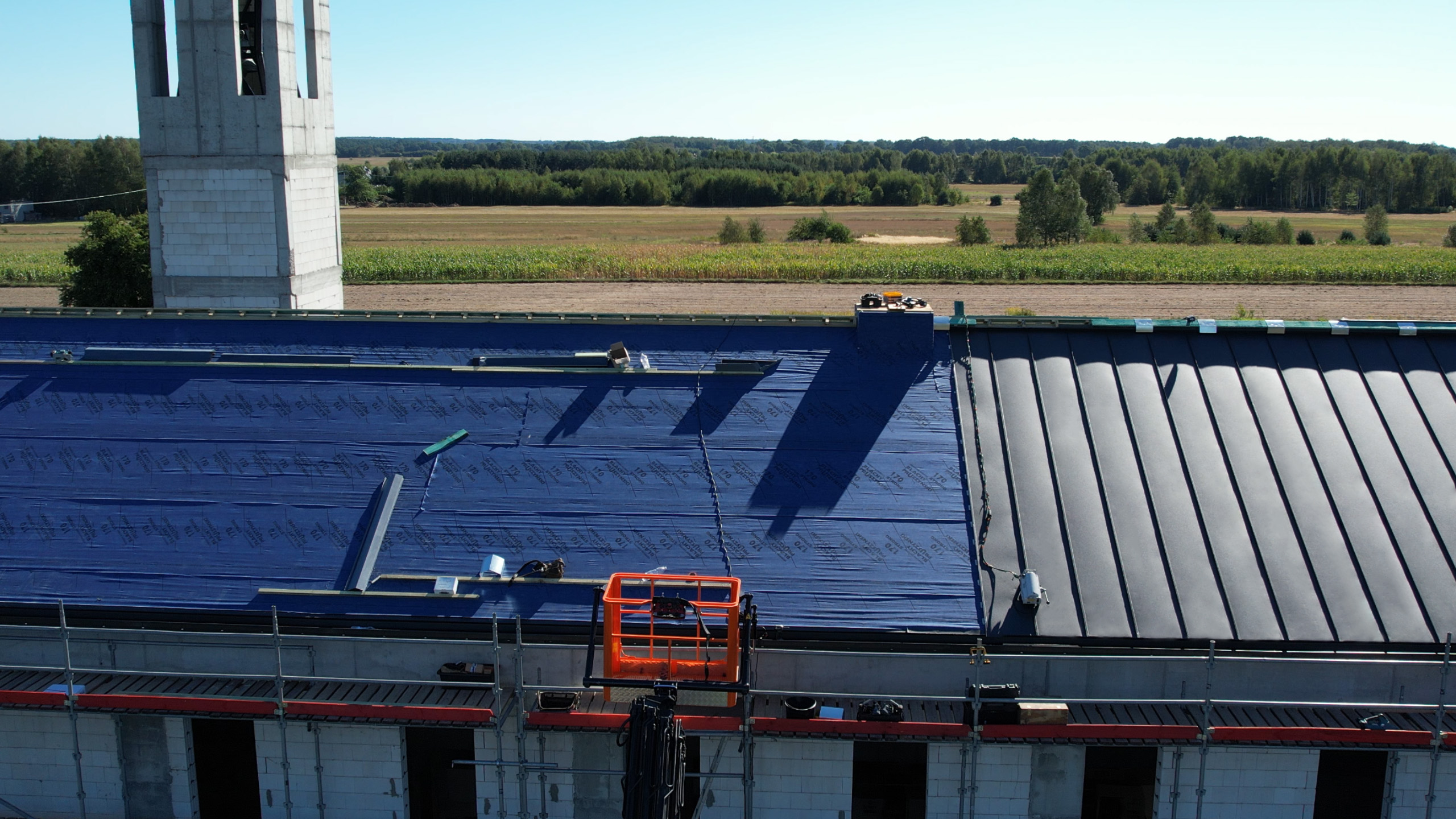
In summary, the choice of solution depends on whether the roof has thermal insulation. In insulated roofs, roof membranes are used as a pre-covering layer, while in uninsulated roofs with roofing metal sheets, the use of anti-condensation nonwoven fabric is permitted.
The choice depends on the roof’s layer configuration and how it handles moisture.
| Feature | Roof membranes | Anti-condensation nonwoven fabric |
|---|---|---|
| Location within the roof structure | A standalone pre-covering layer, installed beneath the roofing material | A sheet metal roofing element permanently attached to it |
| Structure of the material | Multilayer (functional core + protective layers) | A uniform layer of synthetic fibers (most commonly polyester) |
| Main Function | A barrier to liquid water while allowing water vapor to pass through | Moisture buffer – absorbs condensation from the underside of the sheet metal |
| Roof Type | Insulated roofs (residential and office buildings) | Uninsulated metal-roofed structures (canopies, warehouses, outbuildings) |
| Odporność na UV | Tall – intended for temporary display | None – protected by a sheet metal cover |
| Standalone layer | Yes | No—only as a sheet metal component |
| Does it replace the other one? | It does not replace the nonwoven fabric in uninsulated metal roofs | It does not replace the membrane in insulated roofs |
Roof membranes are standalone pre-covering layers installed beneath any type of roofing material in insulated roofs—they protect the structure from water and allow water vapor to escape. Anti-condensation nonwoven fabric, on the other hand, is permanently bonded to the metal sheet during the manufacturing process and serves solely as a component of the roofing system—its purpose is to absorb condensation that forms on the underside of the metal sheet.
No. These are two different materials that serve different functions in different types of roofs. Nonwoven fabric does not act as a barrier to rainwater, nor does it provide the vapor permeability required in insulated roofs. Using it instead of a membrane in a roof with thermal insulation will lead to moisture buildup in the insulation layers and damage to the structure.
Anti-condensation nonwoven fabric is used in uninsulated metal-roofed structures—such as sheds, production halls, or outbuildings—where condensation on the underside of the metal sheeting is the main problem. A roof membrane, on the other hand, is the standard solution for insulated roofs—that is, in residential and commercial construction—where it serves as pre-covering.
As a general rule, this is not recommended. In uninsulated roofs with trapezoidal sheets, the membrane is exposed to significant temperature fluctuations and high humidity, which disrupts its normal function. Furthermore, it does not solve the problem of condensation on the underside of the sheet metal—that is precisely what the anti-condensation nonwoven fabric, which is factory-applied to the sheets, is designed to do.
The fibrous layer absorbs water vapor that condenses on the cold surface of the sheet metal, rather than allowing it to run off in the form of droplets. Moisture is temporarily retained within the material’s structure and then gradually released into the space beneath the roofing as temperature conditions change. This eliminates water dripping, moisture buildup in the components beneath the roofing, and the risk of mold growth.
Metal roof tiles are a lightweight and durable roofing material, but their longevity depends largely on […]
Read moreStanding-seam roof panels combine modern design with exceptional functionality. Their elegant appearance, high watertightness, and durability […]
Read moreTrapezoidal sheets are one of the most popular choices in industrial, warehouse, and residential construction. They […]
Read moreChoosing the right roof covering is one of the key decisions when building or renovating a […]
Read moreBlaszane pokrycia dachowe są uniwersalne, łatwe w montażu i pasują do nowoczesnej architektury. Blacha trapezowa, blachodachówka […]
Read moreChoć dach kojarzy się przede wszystkim z tym, co widzimy z zewnątrz, czyli ładnym pokryciem, pod […]
Read more