A roofing estimate is one of the most important documents during a roofing project—whether you’re building a house or renovating one. It’s not just a summary of the final price, but a detailed breakdown of all the work, materials, and technical requirements. A well-prepared roofing cost estimate allows the homeowner to compare bids, control expenses, and avoid unexpected additional charges resulting from an underestimation of the scope of roofing services.
In this post, you’ll learn about the most common problems:
The “Investor’s Guide” series is a practical compendium of knowledge on the investor–contractor relationship. The articles guide readers through the entire construction process—from thorough preparation for the first meeting, through a detailed analysis of cost estimates, to a substantive technical inspection. The series clarifies the division of responsibilities on the construction site, defining the scope of a roofer’s work and the standards for project documentation. Effective communication is key—the guide teaches you how to ask the right questions at every stage of the project to avoid misunderstandings and unforeseen expenses. Together, this guide enables you to build a roof based on mutual trust, clear guidelines, and the highest quality of workmanship.
A roofing estimate is a document that determines whether a roofing project will proceed smoothly and within budget, or turn into a series of costly surprises. It’s not just a summary of the price, but a detailed breakdown of the scope of work, materials, and all elements affecting the final result. An informed investor doesn’t just look at the total amount “at the bottom,” but analyzes exactly what’s included in that figure—because it’s often in the details that additional costs are hidden. A well-prepared cost estimate allows you to compare offers from different contractors, identify differences in the scope of services, and avoid misunderstandings before signing the contract. This gives you control over your expenses and minimizes the risk of additional charges during the roof installation process.
A roof cost estimate is not merely a summary of the “amount due.” It is a document that shows how the cost of the project varies depending on many factors, including: the complexity of the structure, the size of the roof surface, the type of roof covering, and the building materials used.
Professional cost estimates take into account labor, materials, transportation, waste disposal, and other indirect costs. In practice, this means that the investor can see how much a square meter of roof covering costs, what the labor cost for roofers is, and how much is allocated to specific components, such as metal roof tiles, clay roof tiles, gutters, flashings, and insulation.
In addition, the cost estimate helps clarify the relationships between the various stages of the work—for example, how laying a single layer of heat-weldable roofing membrane affects subsequent roofing work or the assembly of gutters. In practice, this means that each stage sets the stage for the next—for example, the precision of the structural work and flashings affects the pace of the work and material consumption, and thus directly impacts the final cost of the project.
A well-prepared cost estimate should be detailed and based on a bill of quantities and a detailed cost calculation.
The bill of quantities should be based on the design and the actual dimensions of the roof, not on rough estimates. It must specify exact quantities: square meters of roof surface area, the length of the gutters, the number of chimneys, roof windows, and elements such as ridge tiles. A well-prepared bill of quantities also accounts for the material allowance required by the shape of the roof surface. It is the bill of quantities that serves as the basis for a reliable calculation and allows for comparing bids from different contractors on an equal footing, often using specialized cost-estimation software that eliminates calculation errors and ensures consistency in the calculations.
The description of all roofing services should be broken down into steps, rather than being vague. The cost estimate must clearly indicate whether it includes the removal of the old roof coverings, preparation of the structure, any necessary repairs to the roof framing (rafters, purlins), the construction of the formwork, the installation of the fascia board, the laying of the roofing material, and the finishing work. This section should also specify tasks such as sheet metal work on the chimney, assembly of flashings, assembly of gutters, and assembly of chimney bases—without these, the scope of roofing services is incomplete and may result in additional costs during the roof installation process.
For more extensive projects—including attic insulation—the cost estimate must also include the assembly of an insulation layer or a vapor barrier, even though these tasks are performed from inside the building. This is because some roofing companies handle entire building structures comprehensively, rather than just the roof covering.
The cost estimate should include a detailed list of building materials along with their specifications, not just general names. In addition to items such as metal roof tiles, clay roof tiles, heat-weldable roofing felt, plastic sheeting, sheet metal, and PVC gutters, specific systems, thicknesses, quality grades, and manufacturers should be specified. The quantities of materials are also important—for example, square meters of roofing, running meters of flashings, or the number of system components (such as ridge tiles or roof accessories). A lack of precision in this regard often leads to underestimation and subsequent additional charges.
Remember! Due to differences in the materials used, roofing quotes can have vastly different final prices even when the scope of work is similar. The cost of a roof covering with ceramic tiles will differ from that of a roof covering with metal roofing tiles or roofing felt. These differences also apply to gutters, roofing membranes, insulation, and finishing systems.
Labor costs should be broken down by specific tasks, rather than listed as a single lump sum. The price list should include labor rates for tasks such as roofing, laying roof tiles or metal roof tiles, assembly of roof windows, performance of flashings, assembly of metal chimney flashings, and setting up scaffolding. This allows the client to see which stages are the most costly and how the cost varies depending on the complexity of the roof.
A reliable cost estimate takes into account not only the direct costs of materials and labor, but also additional costs. These should include the transport of materials, securing the construction site, erecting scaffolding, organizing support facilities, logistics, and waste disposal. If these items are missing, they will most likely be added as an additional cost during order fulfillment.
The cost estimate should precisely specify the construction method, as it directly affects the cost and durability of the roof. It should indicate whether the roofing system—whether using clay tiles or metal roofing tiles—includes a standard layer configuration (roof membranes as the pre-covering, counter-battens, and battens), or more complex solutions, such as full sheathing with roofing felt as the pre-covering. It is also important to specify solutions for chimneys, parapets, and roof windows, as well as the method of constructing roof flashings (e.g., flexible flashing). The absence of this information means that the quote is merely illustrative and does not give the investor real control over the scope and costs of the work.
Not all items are always included in the initial estimate. It’s important to know where additional costs might arise:
Attention! A roofer’s liability insurance should not be borne by the investor—it is the contractor’s responsibility and should not be included as a separate item in the cost estimate for the work.
Comparing roofing quotes requires analyzing more than one factor. The final price alone says nothing about the actual scope of work or the quality of the roof—which is why it’s crucial to compare quotes “point by point.”
This is the most important factor to consider when comparing quotes. You should verify that each quote covers the same scope of roofing services: removal of the old roof covering, preparation of the roof structure, repairs to the roof framing, sheathing, assembly of the new roof covering, flashings, gutters, and finishing touches. Equally important is the bill of quantities—that is, specific quantities (e.g., square meters of roof surface, meters of gutters, number of chimneys). If one price list assumes smaller quantities or omits part of the work, it will appear artificially cheaper but will not be comparable to other quotes.
Quotes may vary not only in price but, above all, in the quality of materials. The cost will be different for ceramic roof tiles than for cement tiles or metal roof tiles. Differences also apply to components such as heat-sealable roofing felt, plastic sheeting, PVC or steel gutters, ridge caps, and insulation systems. It’s worth checking whether specific products and specifications are listed, or just general names—a lack of details often means that cheaper substitutes may be used.
When comparing quotes, it’s not enough to look at a single total labor cost. What matters are the rates for individual stages: roofing, roof windows, flashings, and assembly of gutters. Differences in labor costs often stem from the complexity of the roof structure and the experience of the roofers. A low rate may indicate a simplified scope of work or the omission of certain tasks.
This is a method of roof construction that affects both durability and cost. It’s worth checking whether formwork is planned, what layer configuration is used, how the flashings will be installed, and whether all components of the roofing system have been taken into account. Differences in technology often explain the price discrepancies between offers.
A warranty is not only a period of coverage, but also the scope of the roofer’s liability. You should check whether it covers the entire roof or just the labor, and what conditions must be met for it to be valid. A short or vague warranty may indicate that the roofer has limited confidence in the quality of their own services.
The more detailed the cost estimate, the greater the transparency. A well-prepared document breaks down the cost into materials, labor, and overhead, and clearly describes the scope of work. General price lists with a single “roof” item are risky because they do not allow you to identify omissions or compare bids on an equal footing.
Remember! Cheaper doesn’t mean better! A lower price quote doesn’t always mean savings. It often results from omitting certain tasks, underestimating the amount of materials, or failing to account for costs such as transportation or disposal. In practice, such an offer can lead to numerous additional charges during the project, and the final cost of the project may end up being higher than it would have been with a cost estimate prepared accurately from the start.
In a cost estimate, entries regarding “additional” work or “supplementary” materials are one of the most common causes of misunderstandings between the client and the contractor. These do not always refer to unforeseen circumstances—they are often items resulting from the realities of construction that are difficult to estimate accurately at the bidding stage. They may include, among other things:
It is important that the cost estimate clearly specify whether such items are already included in the lump-sum price or are estimated (indicative) costs to be settled only after the work is completed. The lack of such clarification poses a risk to the investor of uncontrolled cost increases during the roof construction process.
First and foremost, you should pay attention to:
It’s also worth carefully checking whether the cost estimate includes all components of the roof covering—from roof tiles and ridge caps, through gutters and flashings, all the way to insulation and underlayment. Only a complete and detailed price list gives the investor real control over costs and helps avoid unexpected expenses.
A good roofing estimate should be clearly structured and specify the scope of work. For example:
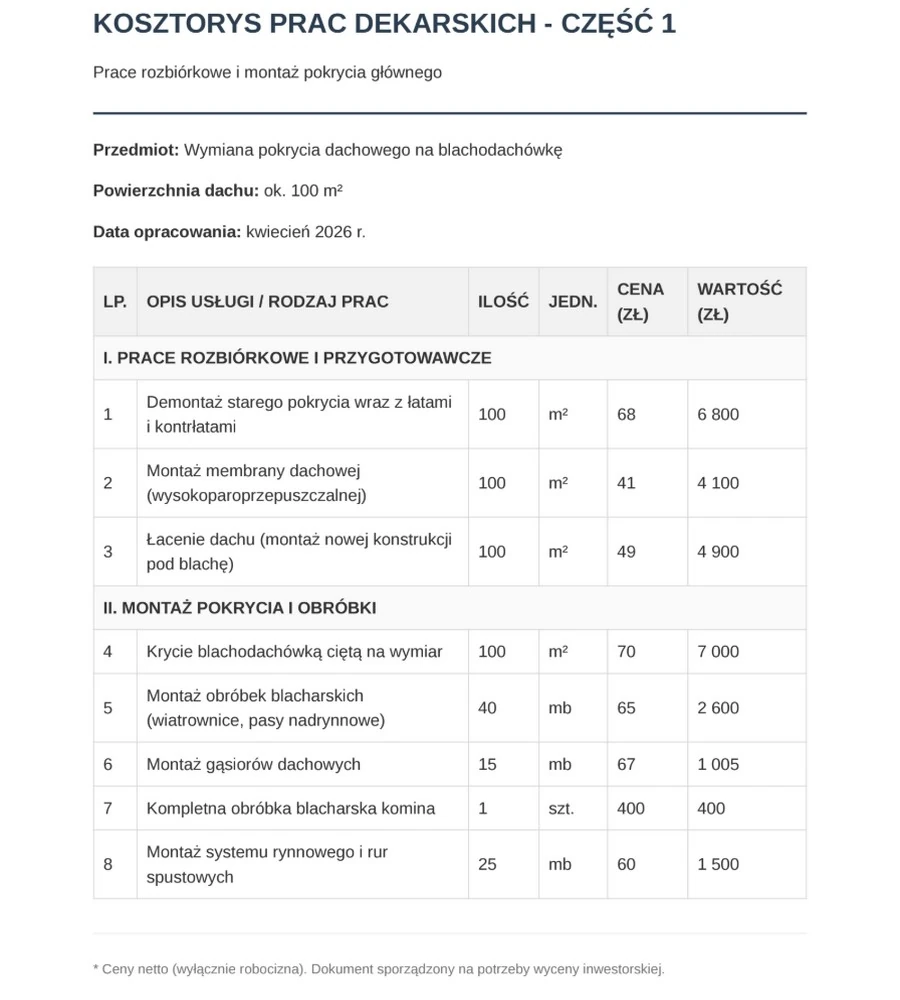
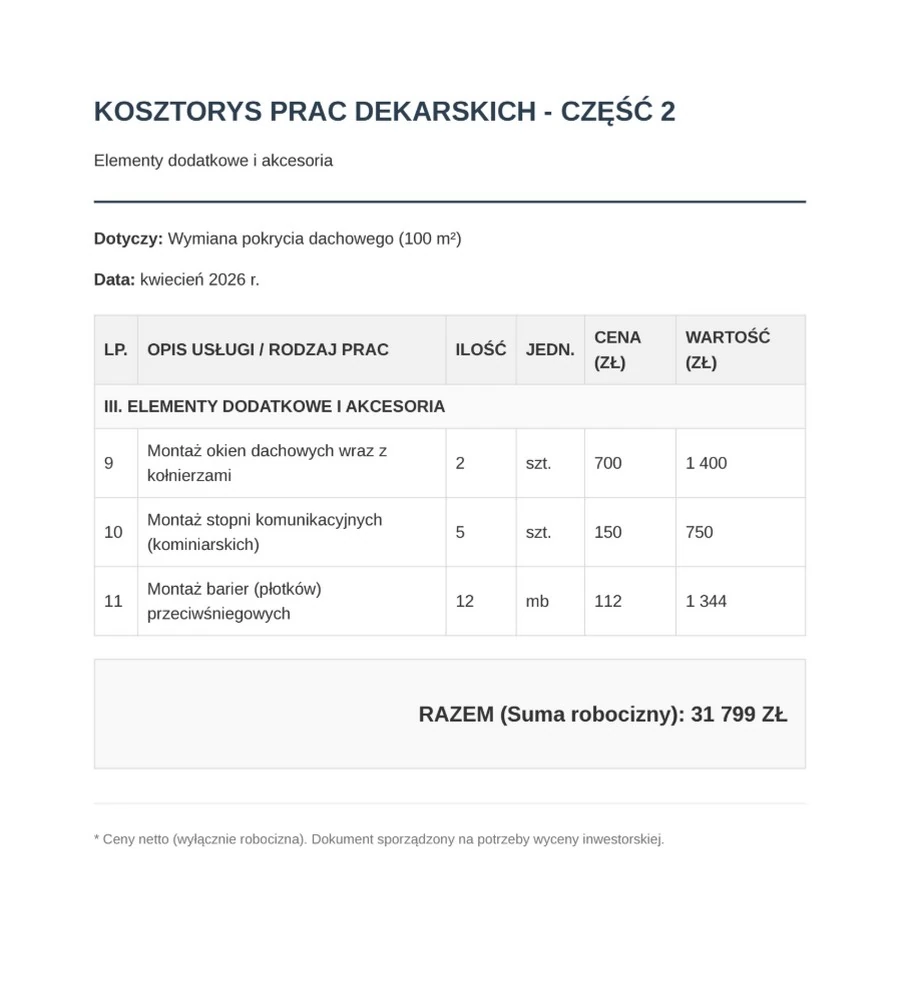
The cost estimate for the roof construction includes: removal of the old roof coverings, preparation of the roof structure, repair of the roof framing (rafters, purlins), installing roof sheathing, assembly of a vapor barrier, laying heat-weldable roofing felt (one layer), installation of insulation, and covering the roof with ceramic tiles. The estimate includes the assembly of PVC gutters, flashings, sheet metal work on the chimney, assembly of roof windows, and chimney bases.
The cost was broken down into materials and labor. The quantities of materials (roof tiles, sheet metal, plastic sheeting, roofing felt), labor rates, and additional costs—including transportation, scaffolding setup, construction site security, and waste disposal—were itemized. The entire estimate was prepared using the detailed method based on the bill of quantities.
This cost estimate gives the investor full control over expenses and allows them to make informed decisions at every stage of roof construction.

Choosing a roofer is one of the key decisions when building a house or renovating a […]
Read moreThe first meeting with a roofer largely determines how the project will proceed. Preparing thoroughly for […]
Read moreA well-prepared investor finds it easier to make decisions when choosing a roofer and reduces the […]
Read moreMartens are clever animals that are increasingly taking up residence in the roofs of single-family homes. […]
Read moreW celu przedłużenia okresu trwałości dachów i elewacji wykonanych z blach powlekanych, niezbędne jest regularne ich […]
Read more