Standing-seam roof panels combine modern design with exceptional functionality. Their elegant appearance, high watertightness, and durability make this system ideal for new construction, renovations, and religious buildings, combining aesthetics with reliable roof protection. The modular design of the standing-seam metal panels allows them to be quickly adapted to almost any roof shape and also simplifies assembly.
In this post, you’ll learn about:
In a series of articles, we would like to introduce you to the specifics of roof construction—its physics, essential elements, key components, and the most common types of roofs found in Poland. The series, titled“The Ins and Outs of Roofs,” will consist of separate, standalone posts, all aimed at familiarizing our customers with the topic of roofs. These posts are created in collaboration with our experts, professionals, and master roofers—who have been working in the field for many years—and are based on educational materials published by the Polish Roofers’ Association (PSD). If you are interested in learning more about this topic, we encourage you to contact the PSD and Roofing Training Centers directly, as well as to review the publications issued by the PSD.
This article discusses standing-seam roof panels —a modern solution that combines elegance with functionality. It explains what a standing seam is and how this system works, presents the available panel options, and suggests where they work best. It also discusses their advantages and disadvantages, issues related to acoustic comfort and soundproofing solutions, as well as the importance of roof ventilation with this type of roof covering.
Standing seam roof coverings are one of the most popular types of roof coverings, used in both new construction and the renovation of older buildings. Standing seam roof panels are a modern variation of this system—they are joined by distinctive 25-mm-high edge tabs, which ensures a tight seal and weather resistance, while also facilitating assembly and adaptation to various roof shapes.
Standing-seam roof panels are made of steel that is galvanized on both sides and additionally coated with appropriate protective and decorative coatings. It is these coatings that protect the roofing from corrosion, UV radiation, and mechanical damage, ensuring the durability and aesthetic appeal of roofs for many years.The Blachy Pruszyński Company’s product range includes, among others, the following coatings: PURLAK – a 50 µm-thick polyurethane coating that provides resistance to UV radiation, corrosion, abrasion, and mechanical damage; PURMAT – a polyurethane coating with enhanced resistance to weather and chemical factors, featuring a coarse-grained matte finish; and polyester coatings – available in both glossy and coarse-grained matte finishes. The standard thickness of the sheet metal used in the panels is 0.50 mm, while a 0.70 mm thickness is available for the flat-embossed version, which provides increased panel rigidity.
Prefabricated standing-seam roof panels are factory-profiled, and the standing seam is fully formed. A key advantage of the system is that the panels snap together without the need to fold the edge—the panels are equipped with special locks that enable quick and precise assembly. On the construction site, the panels are joined using dedicated clips or the manufacturer’s installation systems, which ensure a durable, airtight connection between panels without visible screws. As a result, the roofing retains a minimalist appearance and excellent watertightness, and assembly is quick and efficient. Each panel has pre-drilled bean-shaped mounting holes, facilitating attachment to the structure using pan-head screws. The length of the panels is customized to the specific requirements of the project, which reduces the number of joints and further enhances the airtightness of the entire roofing system.
The Blachy Pruszyński Company offers four models of STAND-UP SEAM panels with various surface profiles, which prevent the material from warping due to thermal expansion. All panels have a usable width of 510 mm and a seam height of 25 mm. The following versions are available:
All panels feature machine-cut interlocking edges that allow them to be assembled on a starter strip, which significantly speeds up and simplifies assembly. The minimum sheet length for all versions is 0.5 m, and the panels can be used on roofs with a minimum slope of 8° (14%).

Standing-seam roof panels are suitable for various types of buildings, both new construction and the renovation of existing structures.
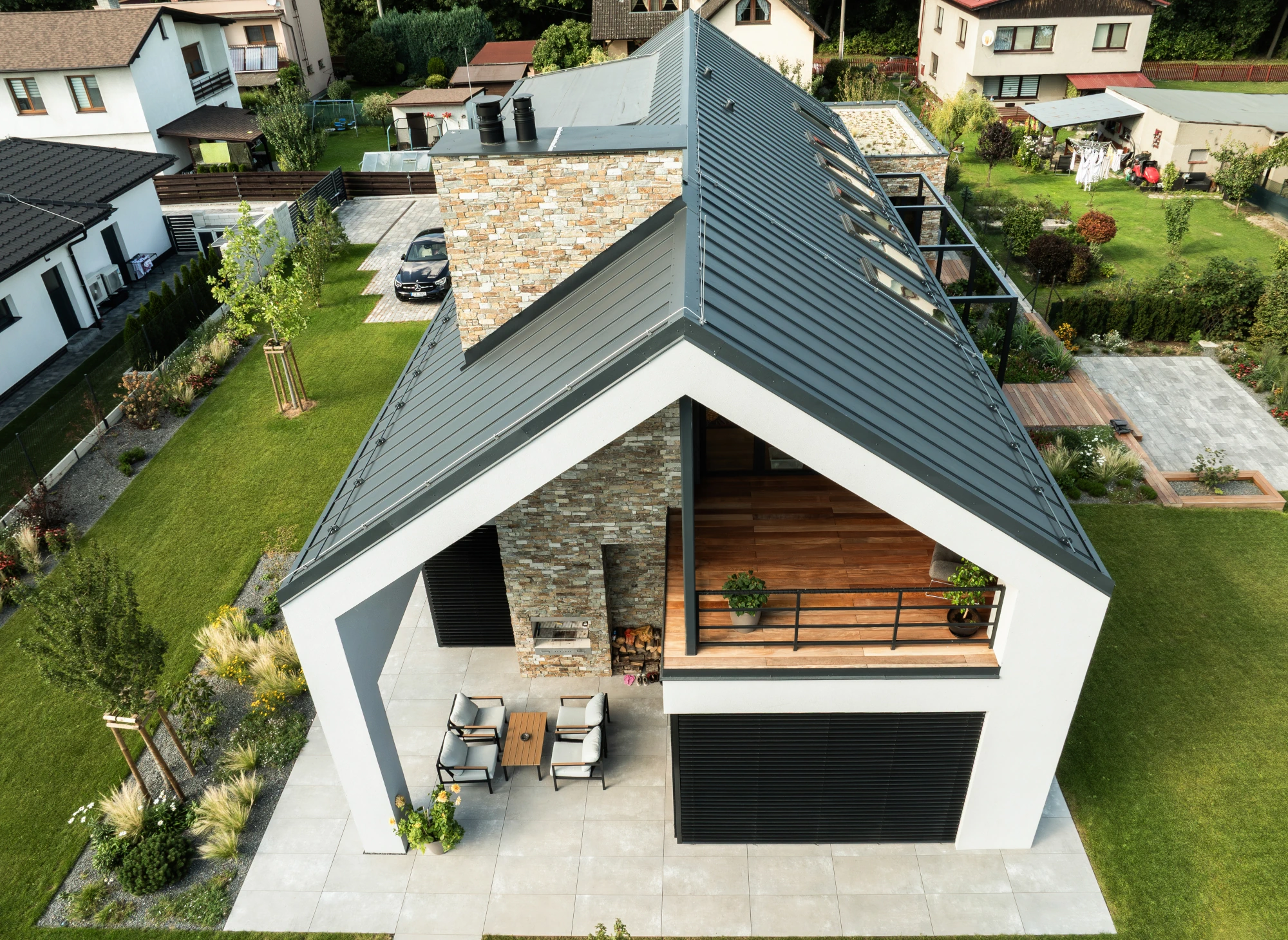
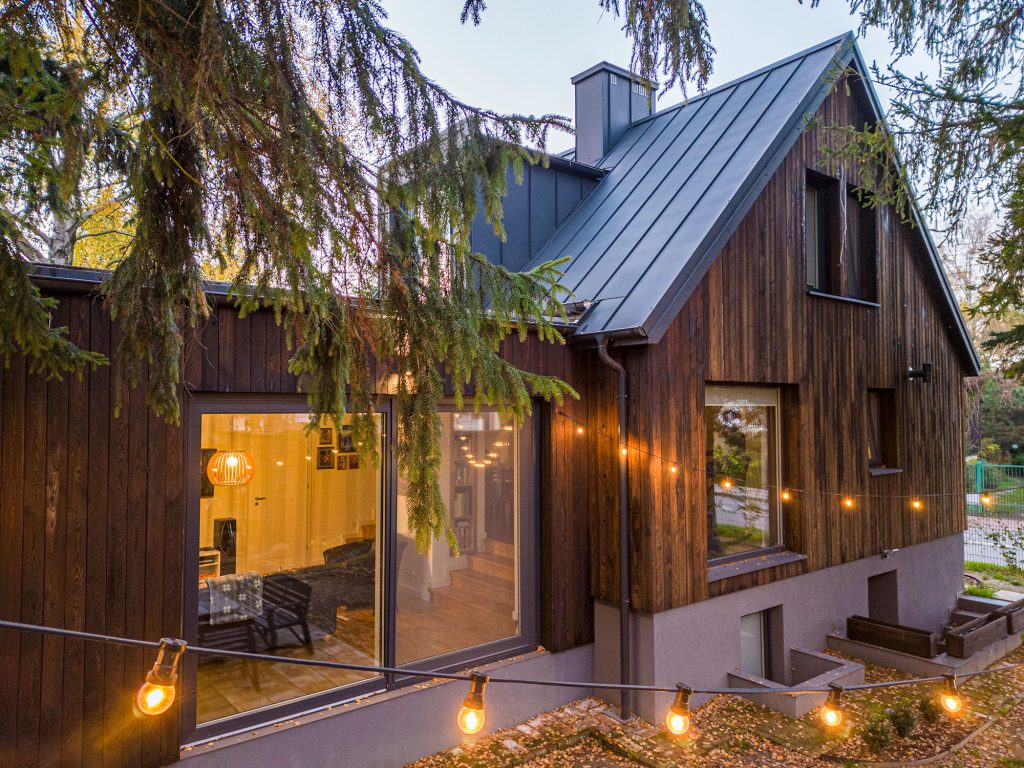
The simple, understated look of standing-seam roof panels fits perfectly with the modern architectural style favored by today’s architects. The long sheets give the roof a uniform appearance, combining functionality with an attractive look. The system blends perfectly with the simple forms of “modern barn”-style buildings, emphasizing their raw, natural character.
When renovating old houses, standing-seam roof panels allow for a quick and durable refresh of the roof coverings. Standing-seam metal roofing preserves the classic look of the roof while ensuring a high level of watertightness and resistance to weather conditions, including heavy rainfall.
Standing-seam metal roofing is often chosen for the renovation of churches and chapels. The roofing’s high level of watertightness protects the roof structure from the elements, and the classic character of the standing seam harmonizes with the style of religious buildings.
During renovation work on historic buildings, standing-seam roof panels ensure durability while preserving the authentic appearance. Standing-seam metal roofing (it is worth noting that trapezoidal sheets can also be used) can be used to supplement existing roof coverings, ensuring a watertight and durable connection to the historic structure.
Thanks to their high resistance to UV radiation, precipitation, and other external factors, standing-seam roof panels are ideal for use on the roofs of shopping centers, office buildings, and schools, among others. The roofing material retains its durability and aesthetic appeal for many years, and the manufacturer offers a warranty of up to 50 years on PURMAT and PURLAK coatings.
In addition to traditional roofs, standing-seam panels can be used to finish modern exterior walls and facades, where their distinctive pattern emphasizes the building’s minimalist character. When performing assembly on a facade, it is essential to ensure proper ventilation—the panels should be at least 4 cm away from the substrate, and the structure should include counter-battens and battens spaced appropriately, as well as ventilation strips. The combination of durability and aesthetics means that this system is increasingly being used to clad exterior walls in both commercial and residential construction.
Standing-seam roof panels offer a number of technical and functional benefits:
Standing-seam roof panels are versatile—they can be used on various types of buildings, including both residential and public structures. Thanks to the material’s durability and resistance to UV radiation and weather conditions, standing seam metal roofing is an investment that will last for many years; it is comparable in durability to metal roof tiles but offers a more austere, minimalist style.

In response to growing demands for acoustic comfort in buildings, PD 510 roof panels can be equipped with special sound-dampening features that significantly reduce noise levels. This is particularly important during heavy rain, hail, or strong winds, when roofing metal sheets can generate disruptive noise.
Sound Control acoustic nonwoven fabric is an acoustic membrane made of 100% polyester fibers that is factory-bonded to the underside of the panels. The material is characterized by high air resistance, which is key to effective sound reduction. Sound Control reduces noise levels by 8 dB, which in practice means a significant improvement in the comfort of using attics. The membrane is self-adhesive, non-flammable, resistant to bacteria, and does not emit any harmful substances, making it safe for use in any type of building. Additionally, it can be used in combination with mineral wool or similar materials, acting as a protective barrier that prevents fine particles (dust, fibers) from penetrating through the ceiling covering into the rooms.
Ventsol Akustic soundproofing tape is an excellent alternative to roof panels with factory-applied acoustic nonwoven fabric. Its key advantage is its flexibility of use—the contractor decides when and how to apply it, often in response to specifications in the construction drawings or design changes that involve adjustments to the technology or materials used for the attic’s thermal and acoustic insulation. Ventsol Akustic tape is recommended wherever there is concern about excessive noise generated by steel roof coverings, particularly on roofs with large slopes, in buildings with open spaces, and in locations exposed to strong gusts of wind. The manufacturer claims a noise reduction of approximately 4–6 dB, which in practice translates to a noticeable improvement in acoustic comfort for occupants, especially during strong winds and heavy rainfall. For this reason, it is recommended to use Ventsol Akustic tape on any roof constructed using click-lock standing seam panel technology, whether in residential, commercial, or public buildings.

Like any solution, standing-seam roof panels also have certain limitations:
In addition, assembly requires precision in joining the flanges and applying the correct tightening torque to the mounting screws—over-tightening restricts the thermal expansion of the sheets (the thermal expansion of steel is approximately 10–11 mm/10 m), while fastening them too loosely can cause deformation. Assembly errors can lead to leaks and subsequent problems with rainwater, which reduces the durability of the entire roof covering.
Effective roof deck ventilation is an essential part of proper standing seam panel assembly and is crucial for ensuring many years of trouble-free service life for the roofing system. A lack of ventilation or improper installation can lead to water vapor condensation under the metal roofing, moisture penetration into the roof layers, and accelerated corrosion of structural components.
A properly designed ventilation system should ensure a free, continuous flow of air from the inlets located in the eaves all the way to the outlets at the Ridge or corners of the roof. This arrangement allows water vapor to be effectively removed before it condenses on the underside of the roof coverings. For roofs with solid sheathing and a layer of roofing felt, it is necessary to maintain a so-called “bottom air gap” 2–4 cm high, which serves as a ventilation space between the sheathing and the standing seam panels. Additionally, depending on the roof’s geometry, ventilation chimneys or vents are installed in the gable walls to aid air circulation. Proper ventilation in the eave area is particularly important. It is recommended to use ventilation strips with two or three rows of ventilation openings. Air is vented along the ridge using special under-ridge strips. These elements allow the roof surface to “breathe” while protecting it from snow, rain, and dust blowing under the roofing material.
Standing-seam roof panels combine elegance, durability, and functionality. The system is widely used in both modern residential construction and renovation projects involving historic or religious buildings. The versatility of the panels allows them to be used not only on roofs but also on the facades of commercial and residential buildings.
The roofing material, made of galvanized steel protected by high-quality protective coatings (PURLAK, PURMAT), guarantees durability and reliability for many years of use. The availability of four profiling options (flat, micro-trapezoidal, micro-wave, nano-wave) allows for precise customization of the appearance to match the architectural concept, while acoustic solutions (Sound Control, Ventsol Akustic tape) ensure comfort even under the most demanding conditions.
Thanks to its high watertightness, weather resistance, and attractive appearance, standing-seam metal roofing is an excellent alternative to traditional roof coverings, while offering a more minimalist, modern look that fits perfectly with current architectural trends.
Trapezoidal sheets are one of the most popular choices in industrial, warehouse, and residential construction. They […]
Read moreInnowacyjne rozwiązania sprawiły, że nowoczesne powłoki ochronne blachy dachowe nie pełnią już wyłącznie funkcji zabezpieczającej, ale […]
Read moreBlaszane pokrycia dachowe są uniwersalne, łatwe w montażu i pasują do nowoczesnej architektury. Blacha trapezowa, blachodachówka […]
Read moreDynamiczny rozwój rynku energii słonecznej sprawia, że dach przestaje być wyłącznie elementem budynku, a staje się […]
Read moreNieodłącznym elementem nowoczesnego domu jest taras. Bardzo często zadaszony, co umożliwia korzystanie z tej przydomowej przestrzeni […]
Read moreNiechlubne domy-kostki z czasów PRL-u na szczęście odchodzą w zapomnienie. Nie znaczy to jednak wcale, że […]
Read more