Good thermal insulation effectively prevents heat loss, reducing building maintenance costs. Sandwich panels are not only “warm” but also durable, and their performance remains consistent over the years, which yields measurable financial benefits over the course of several heating seasons.
In this post, you’ll learn about:
Sandwich panels consist of a rigid polyurethane foam core and steel sheet cladding on both sides. They are rigid, resistant to mechanical damage, and provide excellent thermal insulation. They are also distinguished by their strength and fire resistance. It is worth noting here that, thanks to technological advances, the new generations of panels with PIR foam have significantly better fire performance than, for example, the EPS polystyrene core that was still widely used until recently. As a result, these panels are used in a wide variety of structures: they are suitable for industrial facilities and public buildings; they are used in small mobile refrigerated units and construction site support buildings; and they are utilized as components of sandwich walls and roofs.
What sets them apart from other insulation materials, such as mineral wool or expanded polystyrene insulation, is primarily their very favorable thermal conductivity coefficient and the continuous adhesive bond between the cladding and the core. After foaming, the core naturally bonds with the claddings during the setting and cooling process, resulting in high rigidity and cohesion of the final product. There is no need to adapt to weather conditions, nor is there a need to use heavy equipment.
PIR foam offers excellent thermal insulation. Sandwich panels P IR with a rigid polyurethane foam core provide excellent protection against heat loss from inside the building. Another important factor is that, thanks to the proper profiling of the panel sides, no thermal bridges form along the edges. Walls, roof—the entire surface of the building envelope is continuous and airtight, both for warm air and water vapor.
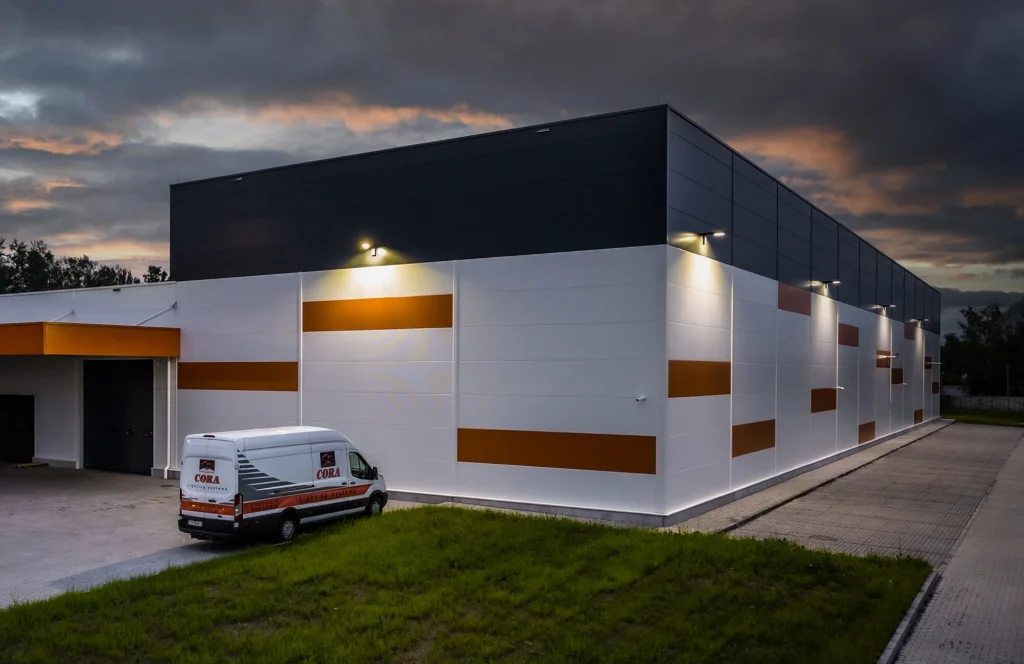
A building with curtain walls and a roof covered with sandwich panels has durable, high-quality insulation and is effectively protected against heat loss.
Furthermore, the PIRTECH sandwich panels offered by Blachy Pruszyński Company are compatible not only with each other but also with panels that have a mineral wool core. If a project requires the use of both types of panels, the transitions and joints between them will always be airtight. This is important for the overall energy balance.
The Blachy Pruszyński Company sandwich panels meet the stringent requirements for the performance characteristics of thermal insulation products for construction. Their thermal conductivity coefficient is λ = 0.022 W/(mK). This is a constant value characteristic of closed-cell polyurethane foam, which forms the core of all panels in the PIRTECH family. However, the final thermal performance of wall panels, or the heat transfer coefficient of individual roof panels, depends on the dimensions of the layer—that is, the thickness of the panels.
Blachy Pruszyński Company offers wall sandwich panels with thicknesses ranging from 40 to 100 mm (PIRTECH Standard – wall sandwich panels with visible fasteners), from 60 to 120 mm (PIRTECH PLUS – wall sandwich panels with concealed fasteners), from 40 to 160 mm (PIRTECH Roof), as well as panels designed for the construction of storage facilities and cold storage units with thicknesses ranging from 120 to 200 mm (PIRTECH Cold Storage).
Sandwich panels for wall cladding with a thickness of 60 mm have a thermal transmittance coefficient of U = 0.40 W/(m²K); those with a thickness of 100 mm have U = 0.23 W/(m²K), and 120-mm-thick wall panels have a U-value of 0.19 W/(m²K).
The thermal transmittance of roof panels with a minimum thickness of 40 mm is 0.53 W/(m²K); at 100 mm, it is 0.22 W/(m²K), and panels designed for building roof cladding—namely, PIRTECH Dach 160 mm—have a U-value of 0.13 W/(m²K).
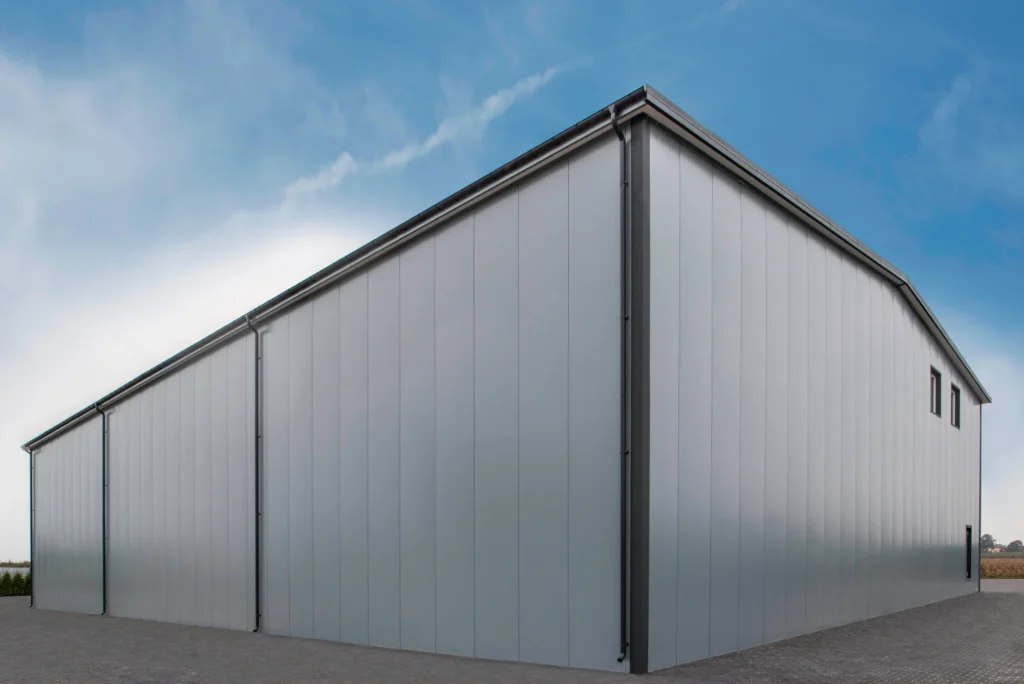
Industrial and public buildings have their own specific characteristics, but as is the case everywhere, energy efficiency depends primarily on good thermal insulation of the walls and roof. Sandwich panels with steel sheet cladding and a polyurethane foam core are among the materials with the lowest thermal conductivity coefficients. Using them in sandwich wall and roof structures ensures the best thermal protection and the lowest heat loss through the building envelope.
Limiting heat loss directly translates into a reduction in the amount of energy needed for heating and, consequently, lower costs. Furthermore, tight thermal insulation with high thermal resistance helps increase the recovery of residual heat generated by operating machinery or the presence of people. These are also valuable kilowatt-hours that, with an inefficient insulation solution, would be dissipated and, in practice, lost.
As with any construction solution, product quality is crucial. When selecting wall panels and roofing panels, it’s a good idea to consider the manufacturer’s reputation and the reviews shared by customers and contractors.
Cheap building materials—even though they may seem more affordable at first—can become significantly less effective after a few seasons because they age and partially lose their thermal insulation properties. Products from trusted brands, such as Blachy Pruszyński Company, come with a documented warranty of durability and consistent performance over the years. Furthermore, reputable manufacturers regularly test their products and have them certified in professional laboratories, where it is possible to artificially age the products and verify their properties over time. As a result, when you decide to purchase such products, you can be confident in their durability and the maintenance of their performance characteristics.
When it comes to PIRTECH panels, annual heating costs depend on the size and purpose of the building, as well as the type of panels selected.
It is assumed that in a room with an area of 10 m², the difference in heating energy consumption—assuming poor and good insulation of the partitions—averages 0.4 kWh. Without performing precise calculations, it can be estimated that by using more energy-efficient solutions for both wall cladding and the roof, for a building with a floor area of 1,000 m², we can reduce heat loss by as much as several tens of thousands of kWh per year. Considering energy prices at 1.20 PLN/kWh, this translates to savings of approximately 100,000 PLN per season. An investment in high-quality sandwich panels can therefore pay for itself in as little as two to three years.
If we were to compare sandwich panels from different manufacturers that have similar initial specifications but differ in price, the theoretical savings would be smaller, and the return on investment would take longer—for example, 10 years; however, one must also take into account quality, necessary maintenance, and the deterioration of the cladding’s properties, which, in practice, shortens this timeframe.
Fill out the contact form—we’ll help you find the best solution and answer all your questions!

Finding a reliable construction team is a big challenge. It is worth looking for a minimum […]
Read moreHow to clean the metal roof tile Roofing tiles on the roofs of Polish houses are […]
Read moreReplacement of the old roofing – what is worth paying attention to? Replacing the old coverage […]
Read more