Browse the page as: Customer
MENU
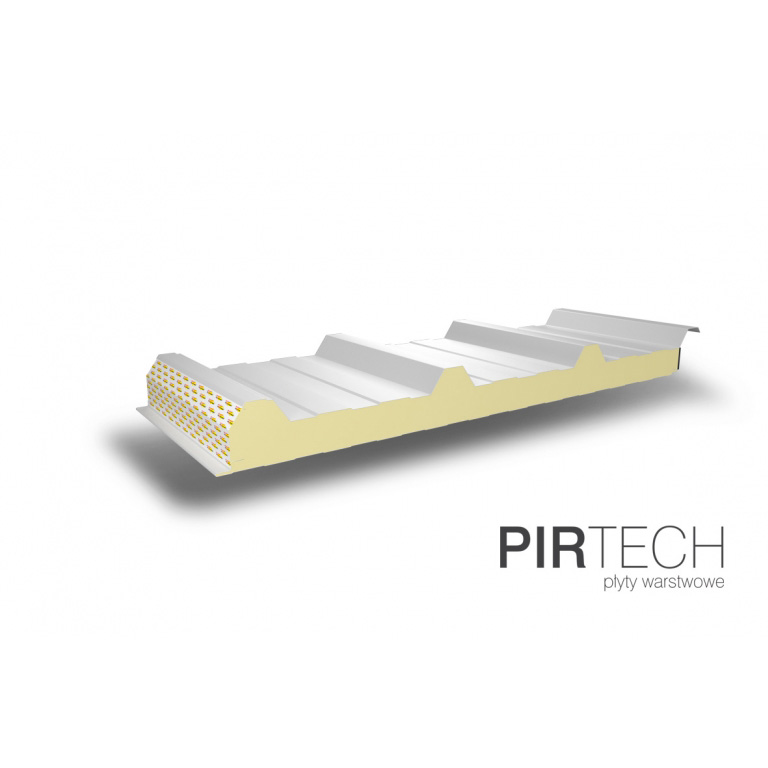
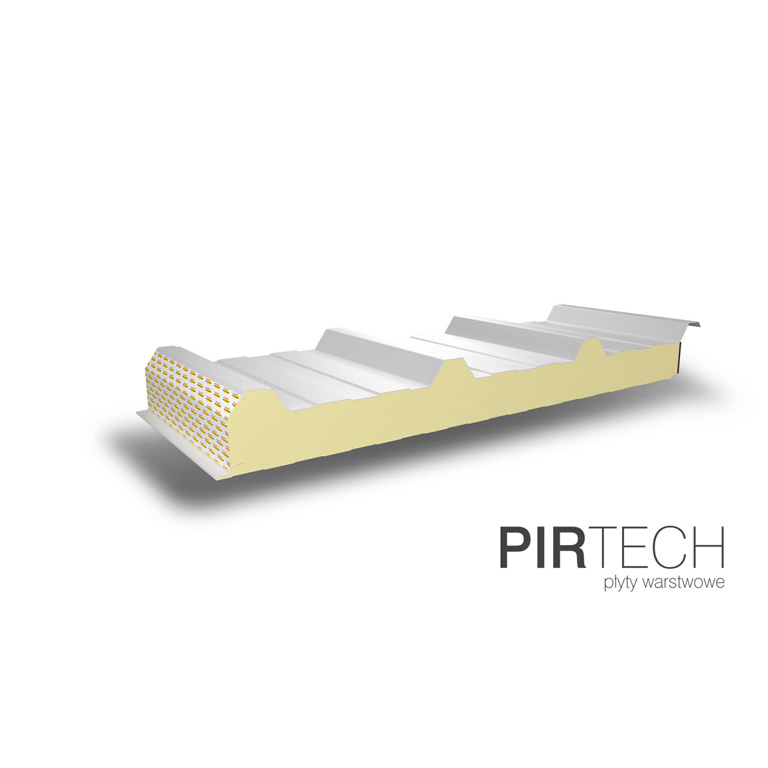
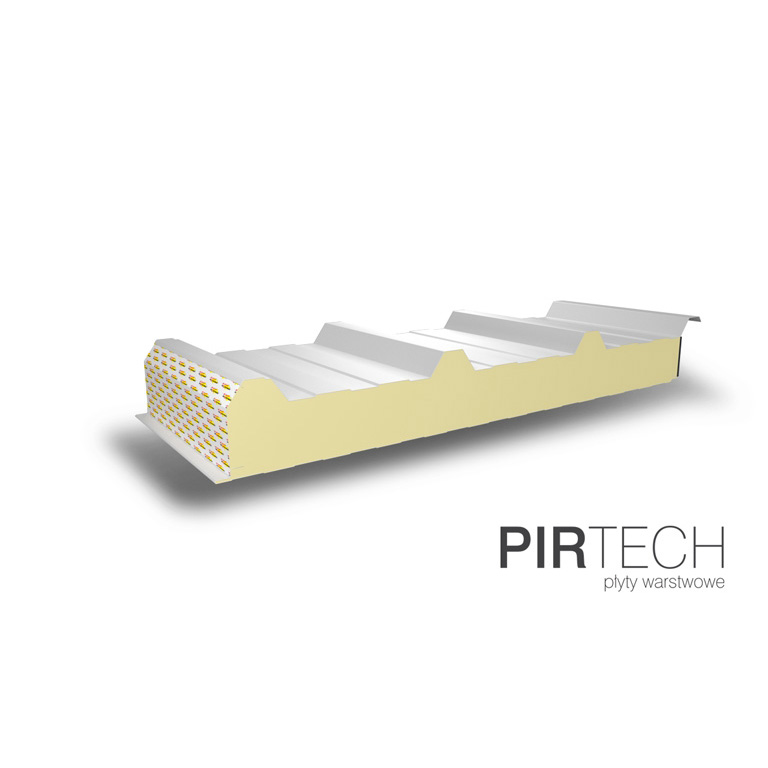
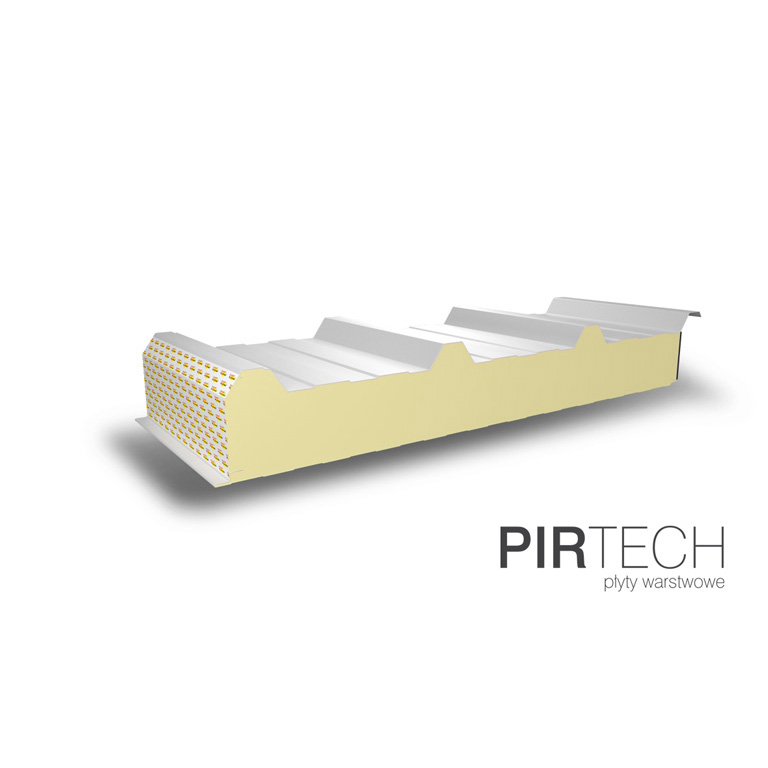
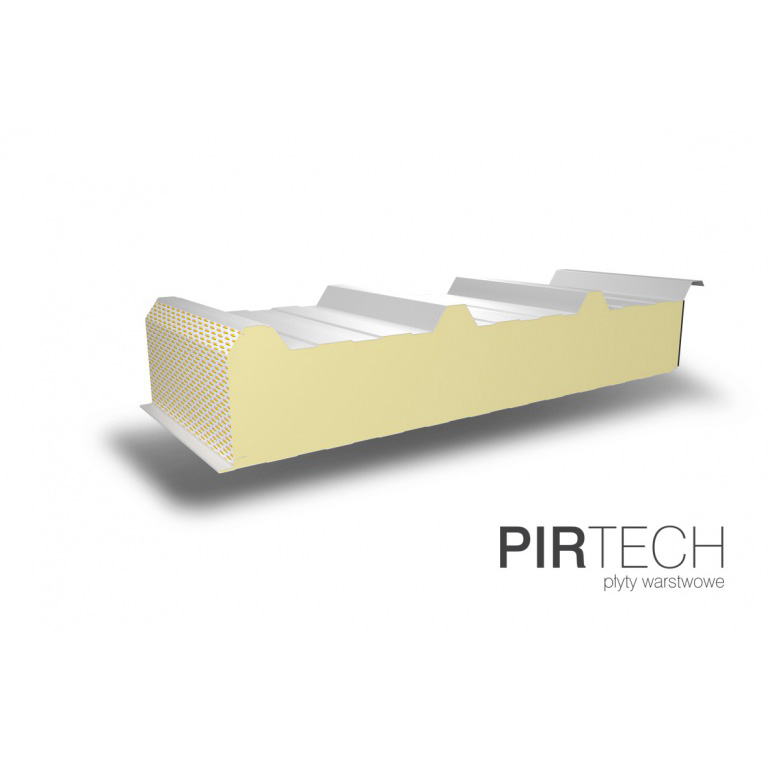
PWD-PIR-40 - Płyta warstwowa dachowa - pianka poliuretanowa - widoczne mocowanie

PWD-PIR-40 - Roof sandwich panel - polyurethane foam - visible fastening

Product Description

PIRTECH PLUS - PWS-PIR-PL-80 - plyta z ukrytym mocowaniem

Panel with visible fastening

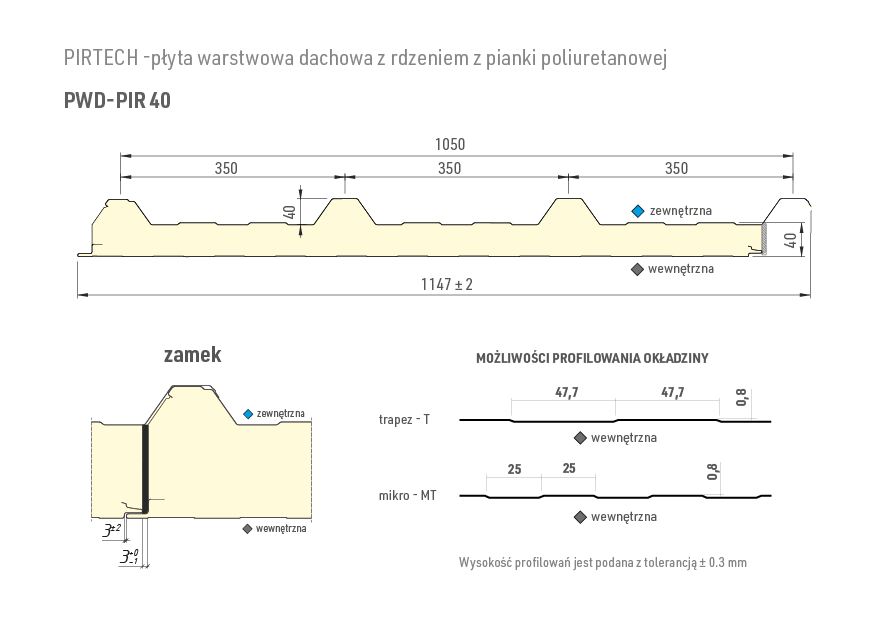
PIRTECH roof panels ( with visible fastening), with a maximum modular width of 1,050 mm, allow for quick and easy assembly on various types of structures using clips and appropriate through-fasteners.

Uniquely designed tongue-and-groove longitudinal joints (locks) ensure excellent airtightness, fire resistance, and quick assembly. The shape of the outer surface (trapezoidal profile) allows it to withstand high loads and makes it suitable for use in single-span and multi-span systems.
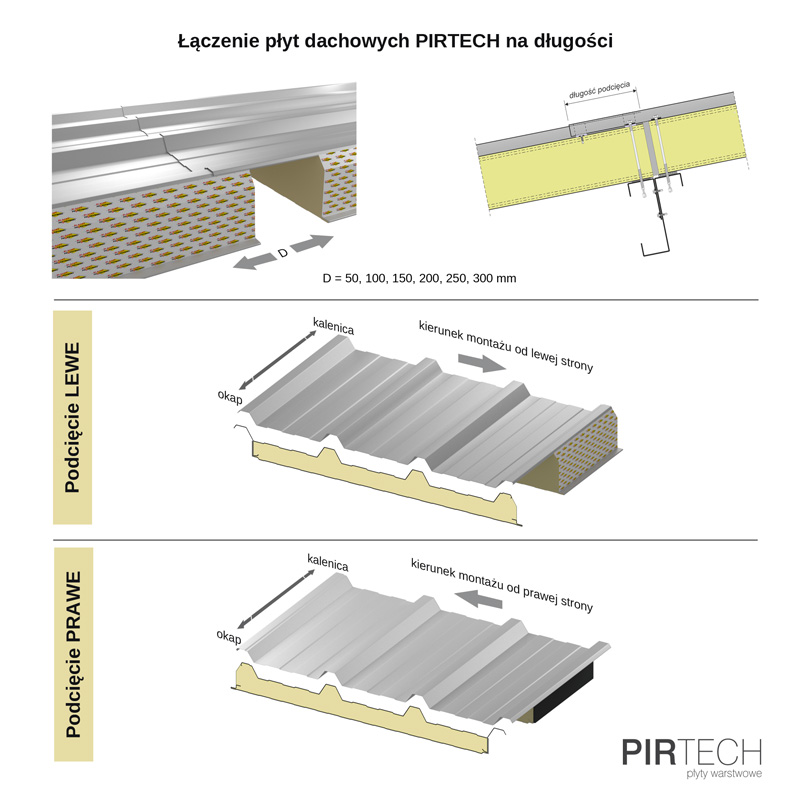
ŁĄCZENIE PŁYT DACHOWYCH PWD-PIR NA DŁUGOŚCI

When joining roof panels end-to-end, it is necessary to cut into the top panel—that is, the panel on the Ridge side.
PIRTECH roof panels can be manufactured with a pre-cut notch ranging from a minimum of 50 to a maximum of 300 mm.
Simply select the type of notch (see figure), which is determined by the direction of assembly:

  • LEFT cutout – assembly from the left side
  • RIGHT cutout – assembly from the right side

The cutout length can be: D = 50, 100, 150, 200, 250, and a maximum of 300 mm.

NOTE: Thetotal length of the panel includes the selected cutout length, regardless of its size.


For example, a sheet 6,000 mm long with a 200 mm cutout = 6,000 mm (5,800 mm core + 200 mm sheet metal).

Blachy Pruszyński Company performs two types of undercuts:

– full cut, i.e., an incision in the inner sheet metal, tape on the outer trapezoidal cladding, and a cut through the entire thickness of the panel core foam,

– Incomplete cut, i.e., an incision in the inner sheet metal and a cut through the entire thickness of the panel core foam.

Custom cut-out widths (applicable only to the range from 50 to 300 mm) are possible, but without tape on the outer trapezoidal cladding, with the foam cut out across the entire thickness of the panel core.

For PWD-PIR 40, 60, 80, 100, and 120 min. panels, the length of panels with a full cutout is 5,000 mm. Panels shorter than 5,000 mm may only be manufactured without tape on the outer trapezoidal cladding.

For PWD-PIR 160 panels, the minimum length of panels with a full cutout is 4,000 mm. PWD-PIR 160 panels shorter than 4,000 mm may only be manufactured without tape on the outer trapezoidal cladding.
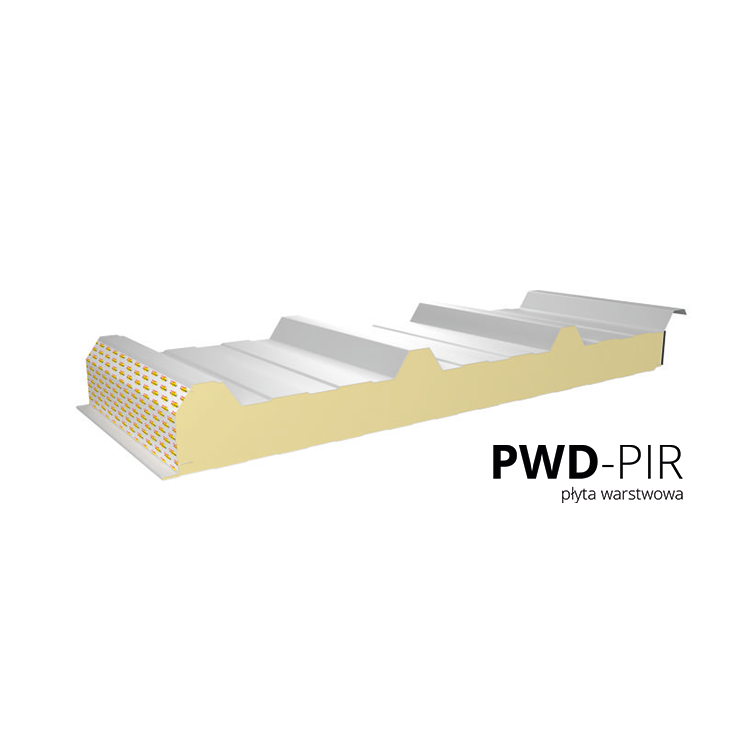
Components

IZOPIR blachy pruszynski kategoria

Core

Rigid PIR polyurethane foam

The production process is carried out using a continuous method on a fully automated line, supplied by Hennecke, one of the industry leaders.

Bulk density: 40.0 kg/m3 ± 3 kg/m3

External steel cladding

Trapezoidal profile sheet

Steel sheet protected by a zinc layer, covered with an organic coating or an aluminium-zinc coating. Stainless steel claddings are also available. The standard thickness for the external cladding is 0.50 mm. Thicknesses ranging from 0.40 mm to 0.70 mm are also available. Trapezoidal profiling allows for high load-bearing capacity and application in single-span and multi-span systems.

Internal steel cladding

Internal steel cladding

High-quality galvanized steel, 0.40 mm – 0.50 mm thick. Standard profiling – Trapezoidal (T) profiling available, with the option of an additional lacquer coating in a color from the available palette.

Longitudinal fastening

Fastening

A special fastening design that limits thermal bridges. The absence of film on the joint and the presence of an additional tongue ensure tighter fit between the two panels, resulting in improved thermal insulation.

Choose a coating:
More information about coatings
PURMATpolyurethane coating, matte

Technical specification of the coating

coating thickness
50 µm
corrosion resistance
High ★★★★
UV resistance
High ★★★★
machinability
High ★★★☆
Technical Warranty
up to 30/50 years

Available colours

PUM R011
PUM R011
PUM R028
PUM R028
PUM RR 033
PUM R033
PUM RR 750
PUM R750
PUM RAL 7016
PUM RAL 7016
PUM RAL 8017
PUM RAL 8017
PURLAKpolyurethane coating, gloss

Technical specification of the coating

coating thickness
50 µm
corrosion resistance
High ★★★★
UV resistance
High ★★★☆
machinability
High ★★★☆

Available colours

PU RAL 7016
PU RAL 7016
PU RAL 9005
PU RAL 9005
PMG35®coarse-grained matte polyester

Technical specification of the coating

coating thickness
35 µm
corrosion resistance
High ★★★☆
UV resistance
Good ★★☆☆
machinability
Good ★★☆☆

Available colours

PMG R011
PMG R011
PMG R028
PMG R028
PMG R032
PMG R032
PMG R033
PMG R033
PMG R750
PMG R750
PMG RAL 7016
PMG RAL 7016
PMG RAL 8017
PMG RAL 8017
PS25glossy polyester

Technical specification of the coating

Coating thickness
25 µm
Corrosion Resistance
High ★★★☆
UV resistance
Good ★★☆☆
Machinability
Good ★★☆☆

Available colours

R028
R028
R032
R032
RAL 1002
RAL 1002
RAL 1015
RAL 1015
RAL 1021
RAL 1021
RAL 3000 probka koloru
RAL 3000
RAL 3005
RAL 3005
RAL 3011
RAL 3011
RAL 3016
RAL 3016
RAL 5010
RAL 5010
RAL 6005
RAL 6005
RAL 6029
RAL 6029
RAL 7000
RAL 7000
RAL 7035
RAL 7035
RAL 9002
RAL 9002
RAL 7016
RAL 7016
RAL 7024
RAL 7024
RAL 8004
RAL 8004
RAL 8017
RAL 8017
RAL 9005
RAL 9005
RAL 9006<br><span style="font-size: 7pt;">SILVER</span>
RAL 9006
SILVER
RAL 9007<br><span style="font-size: 7pt;">SILVER METALLIC</span>
RAL 9007
SILVER METALLIC
RAL 9010
RAL 9010
R028
R028
R032
R032
RAL 1002
RAL 1002
RAL 1015
RAL 1015
RAL 1021
RAL 1021
RAL 3000 probka koloru
RAL 3000
RAL 3005
RAL 3005
RAL 3016
RAL 3016
RAL 5010
RAL 5010
RAL 6005
RAL 6005
RAL 6029
RAL 6029
RAL 7000
RAL 7000
RAL 7035
RAL 7035
RAL 9002
RAL 9002
RAL 7016
RAL 7016
RAL 7024
RAL 7024
RAL 8004
RAL 8004
RAL 8017
RAL 8017
RAL 9005
RAL 9005
RAL 9006<br><span style="font-size: 7pt;">SILVER</span>
RAL 9006
SILVER
RAL 9007<br><span style="font-size: 7pt;">SILVER METALLIC</span>
RAL 9007
SILVER METALLIC
RAL 9010
RAL 9010
RAL 1002
RAL 1002
RAL 3011
RAL 3011
RAL 3016
RAL 3016
RAL 5010
RAL 5010
RAL 6029
RAL 6029
RAL 7035
RAL 7035
RAL 9002
RAL 9002
RAL 7016
RAL 7016
RAL 8017
RAL 8017
RAL 9006<br><span style="font-size: 7pt;">SILVER</span>
RAL 9006
SILVER
RAL 9007<br><span style="font-size: 7pt;">SILVER METALLIC</span>
RAL 9007
SILVER METALLIC
RAL 9010
RAL 9010
The Pruszyński Company guarantees that each order will be produced in the same color (shade). However, due to the complexity of the coating processes, slight variations in shades may occur between individual shipments; therefore, our responsibility for color consistency is limited to a single shipment. When reordering sheets from a specific batch, please indicate on the order form or inform your sales representative that this is a continuation of a previous order and provide a color sample. To ensure color consistency between sandwich panels and other components, such as flashings, please order them from a single supplier.

Inspiration

Technical specification

Technical Information

The polyurethane foam-core roof sandwich panel, manufactured by the Blachy Pruszyński Company, is produced on a state-of-the-art production line in accordance with the highest quality standards. It offers high thermal insulation performance combined with low surface weight. The PIR foam core is sandwiched between two layers of galvanized, coated sheet cladding. Our product line offers a variety of colours and coatings to choose from. The roof profile of the outer cladding (trapezoidal, 40 mm high) ensures excellent water drainage performance.

Depending on how the panels are assembled, the following minimum roof slopes are recommended:
* for roofs constructed with continuous panels (without transverse joints along their length)
** for roofs constructed with panels joined transversely along their length

core
PIR polyurethane
panel thickness
40 mm
effective width
1,050 mm
overall width
1,147 mm
min. roof pitch *
5% (3rd)
min. roof pitch **
7% (4th)
weightper 1 m²
9.90 kg
size: 1 MB
10.39 kg
min. panel length
2.0 mb
Maximum panel length
see - panel lengths
sheet metal thickness
0.5 mm
external profiling
trapezoidal - T40mm
internal profiling
trapezoid - T
coatings
glossy/matte polyester, polyurethane, HPS200
PWD-PIR-40 - Płyta warstwowa dachowa - pianka poliuretanowa - widoczne mocowanie - przekroj

Physical Properties

Material Properties
Thermal conductivity coefficient λD
0.022 W/mK
Heat transfer coefficientUD,S [W/m²K]
0,53
Heat Transfer CoefficientUC [W/m²K]
0,53
Core density
40 ±3 kg/m³
Other Properties
Fire Reaction (All Applications)
B-s1,d0
Fire resistance
NPD
The roof's resistance to external fire
Broof
Water permeability
Class A 1200 Pa
Air permeability
+(C=0.0201, n=0.7506); -(C=0.3664, n=0.5099)
Resistance to concentrated loads
No damage to the core or cladding
Water vapor permeability
Waterproof
Sound insulation against airborne noise
23(0;-3) dB
Sound Absorption
0,20
Creep coefficient t = 200h
1,67
Creep factor t = 100,000 h
2,53
Shelf Life
All colors

Panel lengths

Permissible panel lengths vary depending on the cladding color (minimum length: 2.5 running meters). The assembly of panels exceeding the recommended lengths is the responsibility of the customer.

Colors marked with an asterisk [ * ] are not part of the standard lineup. Orders will be fulfilled only after contacting the sales department and confirming production capacity.

Group I (very light colors)

Maximum length

13,5 m

RAL 9002
RAL 9002
RAL 9010
RAL 9010
<span style="color:#e20a17">RAL 9001*</span>
RAL 9001*

Group II (light colors)

Maximum length

13,5 m

RAL 1002
RAL 1002
RAL 1015
RAL 1015
RAL 1021
RAL 1021
RAL 7000
RAL 7000
RAL 7035
RAL 7035
RAL 9006<br><span style="font-size: 7pt;">SILVER</span>
RAL 9006
SILVER
<span style="color:#e20a17">RAL 1003*</span>
RAL 1003*
<span style="color:#e20a17">RAL 1004*</span>
RAL 1004*
<span style="color:#e20a17">RAL 1014* </span>
RAL 1014*
<span style="color:#e20a17">RAL 1017* </span>
RAL 1017*
<span style="color:#e20a17">RAL 1019*</span>
RAL 1019*
<span style="color:#e20a17">RAL 1023*</span>
RAL 1023*
<span style="color:#e20a17">RAL 1035*</span>
RAL 1035*
<span style="color:#e20a17">RAL 2000*</span>
RAL 2000*
<span style="color:#e20a17">RAL 2003*</span>
RAL 2003*
<span style="color:#e20a17">RAL 2004*</span>
RAL 2004*
<span style="color:#e20a17">RAL 2008*</span>
RAL 2008*
<span style="color:#e20a17">RAL 2009*</span>
RAL 2009*
<span style="color:#e20a17">RAL 5012*</span>
RAL 5012*
<span style="color:#e20a17">RAL 5018*</span>
RAL 5018*
<span style="color:#e20a17">RAL 5024*</span>
RAL 5024*
<span style="color:#e20a17">RAL 6018*</span>
RAL 6018*
<span style="color:#e20a17">RAL 6021*</span>
RAL 6021*
<span style="color:#e20a17">RAL 6033*</span>
RAL 6033*
<span style="color:#e20a17">RAL 7037*</span>
RAL 7037*
<span style="color:#e20a17">RAL 7040*</span>
RAL 7040*
<span style="color:#e20a17">RAL 9022*</span>
RAL 9022*

Group III (dark colors)

Maximum length

12 m

RAL 3005
RAL 3005
RAL 3011
RAL 3011
RAL 5010
RAL 5010
RAL 6005
RAL 6005
RAL 6029
RAL 6029
RAL 7016
RAL 7016
RAL 7024
RAL 7024
RAL 8017
RAL 8017
RAL 8023<br><span style="font-size: 7pt;">COPPER</span>
RAL 8023
COPPER
RAL 9005
RAL 9005
RAL 9007<br><span style="font-size: 7pt;">SILVER METALLIC</span>
RAL 9007
SILVER METALLIC
PMG R750
PMG R750
PMG R011
PMG R011
PMG R028
PMG R028
PMG R033
PMG R033
Dark Walnut
Dark Walnut
Golden Oak
Golden Oak
PUM R028
PUM R028
<span style="color:#e20a17">RAL 3000*</span>
RAL 3000*
<span style="color:#e20a17">RAL 3002*</span>
RAL 3002*
<span style="color:#e20a17">RAL 3003*</span>
RAL 3003*
<span style="color:#e20a17">RAL 3013*</span>
RAL 3013*
<span style="color:#e20a17">RAL 5002*</span>
RAL 5002*
<span style="color:#e20a17">RAL 5005*</span>
RAL 5005*
<span style="color:#e20a17">RAL 5009*</span>
RAL 5009*
<span style="color:#e20a17">RAL 5011*</span>
RAL 5011*
<span style="color:#e20a17">RAL 5022*</span>
RAL 5022*
<span style="color:#e20a17">RAL 6000*</span>
RAL 6000*
<span style="color:#e20a17">RAL 6003*</span>
RAL 6003*
<span style="color:#e20a17">RAL 6011*</span>
RAL 6011*
<span style="color:#e20a17">RAL 6020*</span>
RAL 6020*
<span style="color:#e20a17">RAL 7015*</span>
RAL 7015*
<span style="color:#e20a17">RAL 7022*</span>
RAL 7022*
<span style="color:#e20a17">RAL 8016*</span>
RAL 8016*
ATTENTION! Given that dark-colored panels in Group III are subject to significantly higher thermal loads than very light- and light-colored panels in Groups I and II, it is necessary to assess, during the design phase and depending on the loads, which panel layout on the roof is feasible. Read more below.

Recommendations for Selecting Plates in the Context of Thermal Loads

When designing, temperature differences between the claddings of sandwich panels must be taken into account. The temperature gradients resulting from the difference between the outdoor temperatureT1 and the indoor temperatureT2 depend on several factors:

  • intended use of the facility (temperature range inside the facility –T2)
  • Location of the building—its orientation relative to the sun
  • color of the exterior cladding (T1).

Depending on latitude, elevation above sea level, and distance from the sea, four different winter temperature levels are used on the European continent (T1—exterior cladding):

  • 0,-10°C,
  • 0,-20°C, (e.g., Poland)
  • 0,-30°C(e.g., Scandinavian countries)

The temperature of the outer cladding for roof panels covered with a layer of snow is0°C.

An outdoor temperature of -20 °Cduring the winter was used for the calculations.

The temperature of the exterior cladding,T1, reaches its maximum value in the summer and depends on the color and reflectivity of the surface. TheT1 values, which are the minimum values for strength-of-resistance (SGN) calculations and are appropriate for serviceability limit state (SGU) calculations, are adopted as follows:

  • Very bright colors:RG = 75–90,T1 = +55oC
  • light colorsRG = 40–74T1 =+65°C
  • dark colorsRG = 8–39T1 =+80°C

whereRG is the reflectance of the rays relative to magnesium oxide = 100%

The table above shows a classification by color group for the individual colors available in the Pruszyński Company product line.

The assembly of sandwich panels in light and very light colors (Color Groups I and II) should be carried out when the outdoor air temperature is between +5°C and +35°C, whereas panels with dark-colored cladding (Color Group III) should be installed when the outdoor air temperature ranges from +10°C to +35°C.

Shipping Recommendations

Recommended modes of transportation for sandwich panels:

  • a truck (tractor unit + semi-trailer with a length no shorter than the length of the loaded panels) with an open semi-trailer or one that allows for side loading on both sides along its entire length
  • The load weight must not exceed the permissible load capacity of the vehicle combination,
  • Transport straps should be placed on the load at intervals of no more than 3 m, but no fewer than 2 straps per package—the tension of the straps must not cause the slabs to deform.

Storage Recommendations

Sandwich panels should be stored in stacks; a maximum of two stacks may be placed on top of each other.

The table below lists the maximum number of panels that can be packed together in a single package.

panel thicknessPWD-PIR
40 mm18 pcs.
60 mm14 pcs.
80 mm10 pcs.
100 mm8 pcs.
120 mm8 pcs.
160 mm6 pcs.
  • It is recommended to store the panels on a level surface (yard, warehouse) on joists or polystyrene pads, which must be spaced no more than 2.5 m apart (for panels with a total length of up to 2.5 m, use at least 3 blocks).
  • A maximum of two stacks of boards up to 6 meters in height may be stacked on top of each other; stacks of boards exceeding 1 meter in height must be stored individually. All stacks of boards must be stored on a level surface with proper drainage.
  • When storing panels on a construction site, they must be protected against mechanical damage, UV exposure, harsh environmental conditions (acids, fertilizers, salts, and other corrosive agents), precipitation, strong winds, and other factors.
  • It is recommended to store packages under a roof in well-ventilated areas
  • The panels should be stored on a level surface (yard, warehouse) on joists, on polystyrene or wooden supports, which must be spaced no more than 2.5 m apart (for panels with a total length of up to 2.5 m, use at least 3 supports).
  • Protective films are used to provide additional protection for the surfaces of the panels against mechanical damage, stress, and impacts that may occur during transport or handling. These films do not exempt users from the obligation to properly secure the panels during storage.
  • It is recommended to remove the protective film before installing the components on the building’s facade or roof. The film should be removed when the air temperature is above freezing, because at sub-freezing temperatures the adhesive delaminates and some of its components may remain on the sheet metal.
  • Improper storage of the sheets may make it difficult to remove the protective film and may leave adhesive residue on the surface of the sheets. In such cases, the Manufacturer will not honor claims regarding adhesive residue left by the protective film.
  • For panels with hidden fasteners, be sure to remove the film from the inside of the longer lock before assembly.

ATTENTION!!!

For wall panels with visible fastening (applies to PIR panels), the top side of the panels in the package is the facade side—please pay special attention to this!

Maintenance and Cleaning

To extend the service life of roofs and facades made of coated sheet metal, they should be inspected and maintained regularly.

  • Inspection – Once a year (preferably in the spring), you should inspect the roof and exterior walls to detect any damage early on.
  • Cleaning Sheet Metal – Roofs and facades made of coated sheet metal require cleaning at least once a year. Dirt that accumulates on the sheet metal can cause uneven discoloration (due to uneven exposure to UV rays) and reduce corrosion resistance (dirt traps moisture on the sheet metal, gradually damaging it). Dirty and stained areas can be cleaned with a soft brush and water (max. 60°C). If necessary, a mild detergent (pH 6–7, max. 10% solution) may be added to the water. Pressurized water (max. 100 bar) may also be used for cleaning; however, the water jet must not be directed too close to the panel surface (min. 30 cm) nor perpendicular to the surface. At the joints, the water jet should be directed downward to prevent pressurized water from penetrating the gaps around the joints. Old panel coatings must be handled with extreme care. Cleaning should be performed from top to bottom, and the cleaned area should always be thoroughly rinsed with clean water immediately.
  • Do not use scouring powders, nitro solvents, chlorine-based solutions, aromatic cleaners, or products containing ammonium chloride or sodium salts.
  • Damage — Any damage that occurs during the Warranty period must be discussed with the roofing/facade contractor and may be repaired only with the contractor’s written consent. Repairs to small areas are carried out using air-drying touch-up paints, while painting large areas is generally only possible using special industrial paints designed for the renovation of coatings. The surface to be painted should be limited only to areas that require it (scratches down to the metal, corrosion spots, etc.). Surface preparation for painting should be performed in accordance with generally accepted guidelines. Always thoroughly remove all traces of corrosion—preferably using special brushes or fine-grit sandpaper. Next, the surface to be repaired must be thoroughly dusted, degreased, and cleaned. To degrease the surface, you can use extraction gasoline or water with added surfactants (preferably with a 1–2% ammonia solution). The repaired areas may show color differences compared to the original sheet metal colors due to natural atmospheric effects (aging of the paint under the influence of UV radiation).
  • CAUTION—Health and safety rules must be strictly observed during inspection, cleaning, maintenance, and repairs.

Pruszyński Company Sp. z o.o. is not liable for any accidents that may occur as a result of performing the above activities.

Do you have any questions?

Does the roof need maintenance?
Yes, every roof requires periodic inspections to check for any damage. Most products offered by the Blachy Pruszyński Company are available with various types of specialized coatings (covered by Warranty) that increase the service life and durability of metal roofing. Maintenance mainly involves removing soot and chimney dust, which, if left for an extended period, can damage the metal sheeting. Particular attention should be paid to the areas around chimneys, which are critical due to more demanding operating conditions. If localized damage to the paint coating is noticed during an inspection of the roofing, touch-up painting should be performed. In such situations, the best solution is to use dedicated touch-up paints matched to the specific coating. The Blachy Pruszyński Company offers such paints as part of its regular product line, and it is strongly recommended to use the company’s products that are recommended for the specific coating.
Is it possible to install copper flashings on a steel roof?
Caution must be exercised when using copper, as copper oxides are highly corrosive and cause corrosion of other metals. For this reason, it must not be combined with other types of metals on buildings (copper reacts upon contact and causes electrolytic corrosion of other metals).
Can I use an angle grinder to cut sheets?
Modern roof coverings preclude the use of angle grinders for cutting. Using this method to cut the material will void the Warranty.
An angle grinder generates a great deal of heat during operation and cutting, which in turn damages the edges of the sheet metal as well as its protective coating. Additionally, the metal shavings produced during operation become embedded in the sheet metal’s surface, creating potential corrosion sites.
The proper way to cut sheet metal is to use automatic nibblers or hand shears. These tools use mechanical force to cut the sheet metal without exposing it to extreme temperature fluctuations. Additionally, it’s worth remembering that after cutting, it’s a good idea to protect the cut edges with a dedicated protective varnish or special paint.
Why are metal roof tiles recommended for renovating old roofs?
This is directly related to its light weight. In the case of old roofs, the roof trusses of renovated houses are often already somewhat worn down by time. Therefore, it is safer to use metal roof tiles, which weigh around 4.7 kg/m², rather than ceramic roof tiles, which are nearly ten times heavier. However, it’s always a good idea to have a specialist inspect the condition of the roof truss and confirm whether it requires renovation or replacement after all. In such cases, the safety of the building’s residents or employees, as well as the installation crew, is always the top priority. In most situations, however, the condition of the structure allows for the use of metal roof tiles without major issues, whereas the use of ceramic roof tiles would no longer be possible.
How can I advertise a product? Where can I find more information?
Complaints should be filed at the wholesale store where the purchase was made. If the wholesale store in question has closed (is no longer in business), the completed complaint form should be sent directly to Pruszyński Company at the following address: pruszynski@pruszynski.com.pl

A complaint form is available in the "Downloads / Forms" section or directly here: COMPLAINT FORM
How to register and how does the warranty work?
In order to register the warranty, download the warranty registration available in files for download / printing or directly:
Warranty registration and send it completed to the following address: guarantee@pruszynski.eu

The warranty begins to apply on the day of purchase of the goods. Registration of warranty is necessary to quickly identify the purchased batch of goods.

Other items in this category

Explore our selection of accessories

Articles

CSR, Sponsoring sportowy
The Academy of Crafts Continues to Grow—Paweł Francuz Named New Ambassador, Ryszard Piwowski Named Honorary Ambassador

The Academy of Crafts is embarking on the next phase of its activities. During the annual meeting in Sokołów, plans were made for upcoming training sessions, participation in trade shows and industry events, and other initiatives. The new Brand Ambassador, Paweł Francuz, also attended the meeting. Ryszard Piwowski, who has been associated with the Academy for many years, was named Honorary Ambassador.

Read more
Competitions, CSR, Sponsoring sportowy
2026 PGE Grand Prix — Ustka Once Again the Capital of Summer Volleyball

The 2026 PGE Grand Prix once again drew the best Polish volleyball teams to Ustka. The tournament, played in a 4x4 format, kicks off the 2026–2027 league season and combines athletic competition with the summer atmosphere of the Baltic Sea and attractions prepared for fans.

Read more
Business
Blachy Pruszyński Company is a partner of National Roofers' Day 2026

On July 24–25, the 26th National Roofers’ Day was held in Nałęczów. The event brought together roofers, manufacturers of roofing materials and roof accessories, and industry partners. This year’s celebration was also special because it marked the 25th anniversary of the Lublin Branch of the Polish Roofers’ Association.

Read more