The cold season has been arriving quite late in Poland lately—not until January, or even February. So we have time to ensure the safety of our buildings before winter sets in, including maintaining our roofs and professionally preparing our facades. Freezing temperatures, snow, and moisture can lead to corrosion, cracks, and warping. In this article, we’ll discuss the most important steps to take to protect a building with a trapezoidal sheet metal facade from winter weather conditions and ensure it remains in impeccable condition for many years to come.
In this post, you’ll learn about:
The cold months are harsh in our climate. High humidity, alternating between freezing and above-freezing temperatures, snow piling up against buildings, and strong winds are all factors that are very detrimental to building structures and construction materials.
Trapezoidal sheets have relatively high thermal expansion and are sensitive to temperature fluctuations. The sheets expand and contract, which can lead to leaks and damage along the edges or at screw locations. For this reason, it is a good idea to regularly inspect the condition of the facade, especially the flashings around windows and the joints between sheets.
Due to the moisture in the air, the metal facade must also be protected against corrosion. Trapezoidal sheets from reputable manufacturers, such as Blachy Pruszyński Company, are thick and have a factory-applied zinc coating that protects the steel core against corrosion. However, it’s a good idea to check the condition of the sheet metal annually and look for any scratches, dents, or chips. The protective coating in these areas may have cracked, and deeper scratches may have compromised the zinc coating, leaving the steel exposed and susceptible to rust. If spotted in time, such damage can be repaired quickly.
Trapezoidal sheets don’t like dust settling on their surface, yet they’re most commonly used as roofing and for facade cladding in modern industrial construction. In such applications, in addition to weather conditions, one must certainly also account for the presence of harmful deposits on the sheet metal. Rain is unable to wash them away and may even cause damage, as many compounds react when they come into contact with water (e.g., due to acid rain reacting with the sheet metal’s coating). This is an additional factor that negatively affects the facade in winter.
While preparing the walls of your home, it’s also a good idea to inspect the roof and check the roofing material, the valley gutters, and the eave gutters, which are responsible for draining water from the roof. If necessary, we need to clean the gutters—for example, removing leaves or twigs—and secure the fastenings.
Maintenance work before winter sets in isn’t difficult; we follow a similar procedure when preparing a trapezoidal sheet metal roof—it’s the same material, except that taller profiles are used for the roof.
Check that the trapezoidal sheets have no visible dents or scratches that could become corrosion sites, that the coating isn’t peeling anywhere, and that the edges along the joints aren’t bent back, and that the joints remain tight. Also, carefully inspect the flashings around the windows.
If you notice chips or scratches on the sheet metal, touch them up with touch-up paint—that is, the air-drying paint provided by the manufacturer. This will prevent the damage from getting worse.
If the building is getting on in years, the sheet metal may need to be replaced in some places. You can remove the old piece and install a new one in its place. Just remember to buy sheet metal that matches the original and can be properly joined to it during assembly.
This is particularly important in construction in industrial areas. Pollutants emitted from chimneys, as well as dust from cement plants, steel mills, mines, and lime plants, are harmful to metal facades. When they react with water, such contaminants can damage the organic coating on the metal sheet. The presence of contaminants also causes uneven discoloration of the sheet metal under the influence of UV radiation, as well as localized moisture accumulation, which over time increases susceptibility to corrosion.
Trapezoidal sheets are a very durable material that withstands all weather conditions well, but winter weather is definitely not kind to them.
Contrary to what one might think, the biggest challenge for sheet metal isn’t sustained freezing temperatures, but the constant fluctuation between above- and below-freezing temperatures. In Poland, temperatures dip below and rise above zero degrees—sometimes dozens of times a year. For sheet metal, this means a change in length —admittedly measured in millimeters—but such slight shortening or lengthening adds up across successive sheets, and if thermal expansion was not properly accounted for during Assembly, leaks or warping of the sheet metal may occur.
Be sure to regularly remove snow that has accumulated against the wall. Not only does it pose a risk of moisture penetration, but it also hinders proper ventilation of the space beneath the metal roofing. Accumulated snowdrifts can also cause uneven discoloration on the sheet metal’s protective coating.
Sprinkling sand and salt on the streets and sidewalks near the building can be problematic for the facade. Grains that chip off or water splashing from under the wheels (road salt can also accelerate the corrosion process) expose the coating to abrasion.
Strong winds can be dangerous for older buildings . Sheets that are loose in places—such as those on the roof—can be blown away by gusts. That is why it is so important to check the edges of the sheets and the stability of their fastenings. The new models of facade sheets offered by the Blachy Pruszyński Company can be ordered with a lock-type connection, which improves safety against wind and reduces the risk of moisture penetration beneath the facade.
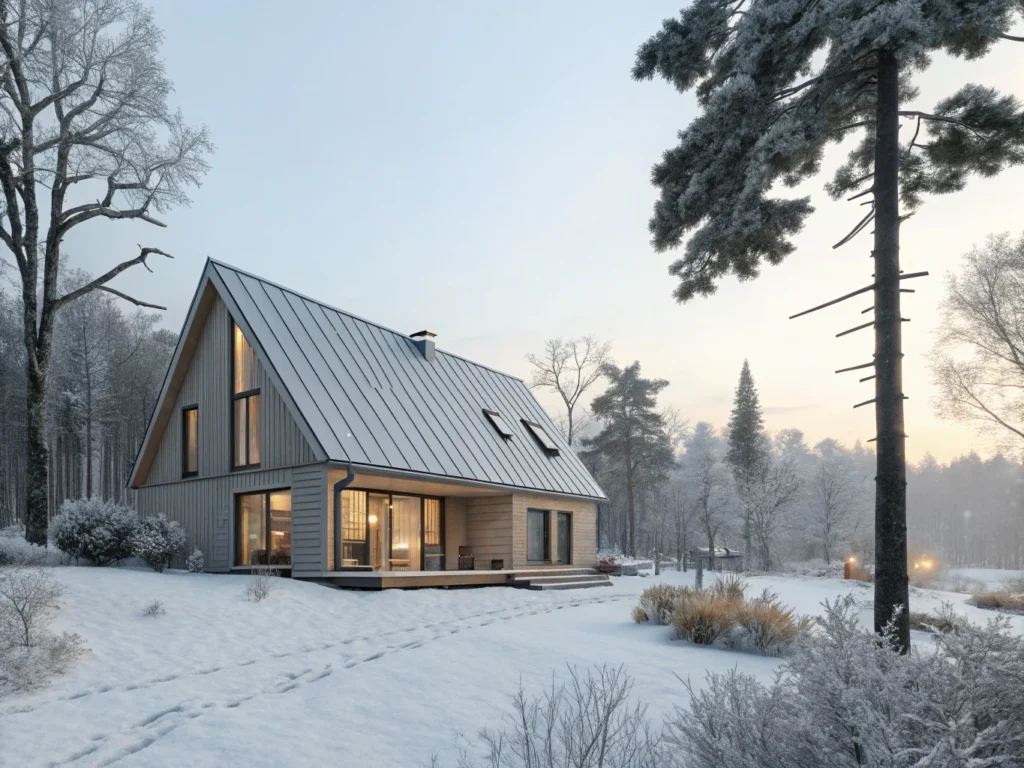
If we don’t inspect the condition of the metal facade before winter and carry out the necessary maintenance, we may find next season that minor damage has worsened and will require more extensive and costly repairs. By the time we finally begin the renovation, the damage will no longer consist of isolated scratches but rather larger patches of damaged material.
Of course, certain tasks, such as cleaning the house, are best done in the summer, but we should take care of the sealing strips and chipped areas year-round, and pay special attention to them before winter sets in. A well-maintained facade will look great for many years to come.
A soft brush or pressure washer will come in handy for cleaning the facade , though the maximum allowable water pressure is 100 bar. Also, make sure the nozzle is no closer than 30 cm from the metal surface.
Any areas where rust has appeared should be cleaned with a brush or fine-grit sandpaper, so it’s a good idea to have these supplies on hand.
If you’re planning major repairs, it’s a good idea to stock up on screws, nails, and sealing strips so you can replace any that are damaged or add them where they’re missing. As for window sills, the insulation tape wears out over time.
Water at a temperature of up to 60 degrees is best for cleaning, but mild detergents designed for delicate surfaces, as well as solutions with a pH of 6–7 and a concentration of no more than 10%, are also suitable.
In areas affected by corrosion, after scrubbing with a brush or sandpaper, extraction gasoline or water containing a 1–2% ammonia solution is suitable for degreasing before repainting.
However, scouring powders, nitro solvents, chlorine-based solutions, or agents containing ammonium chloride or sodium salts must not be used on trapezoidal sheets.
Trapezoidal facade sheets are an excellent choice for an attractive and durable building finish. To ensure it remains problem-free for many years, all you need to do is take care of it. If you’re not sure how best to do this, you can seek advice from experts, such as those at the Blachy Pruszyński Company.
Wybór pokrycia dachowego jest niezwykle ważny i nie chodzi tu tylko o estetyczny wygląd, chociaż on […]
Read moreKondensacja blach dotyka przede wszystkim obiekty, których przegrody nie zostały ocieplone, np. blaszanego garażu czy hali […]
Read moreBlacha trapezowa uznawana jest za produkt przeznaczony do obiektów przemysłowych i komercyjnych. Tymczasem nowoczesne modele blachy […]
Read moreBlaszane pokrycia dachowe od wielu lat cieszą się popularnością. Dla wielu inwestorów oczywistym wyborem są blachodachówki. […]
Read more