Gutter systems must ensure that water is safely drained from the roof. They consist of horizontal and vertical components—namely, gutters and drain pipes—as well as a range of components used to connect and secure them, and finishing details.

In this post, you’ll learn about:
Every gutter system consists of a horizontal and a vertical section, including:
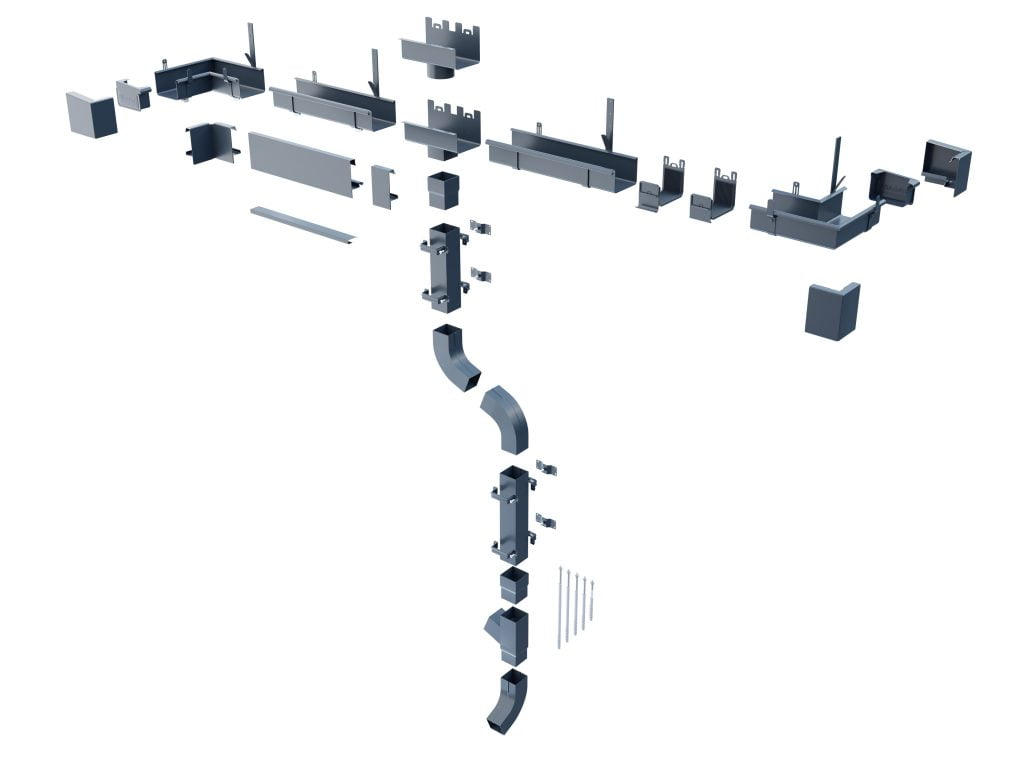
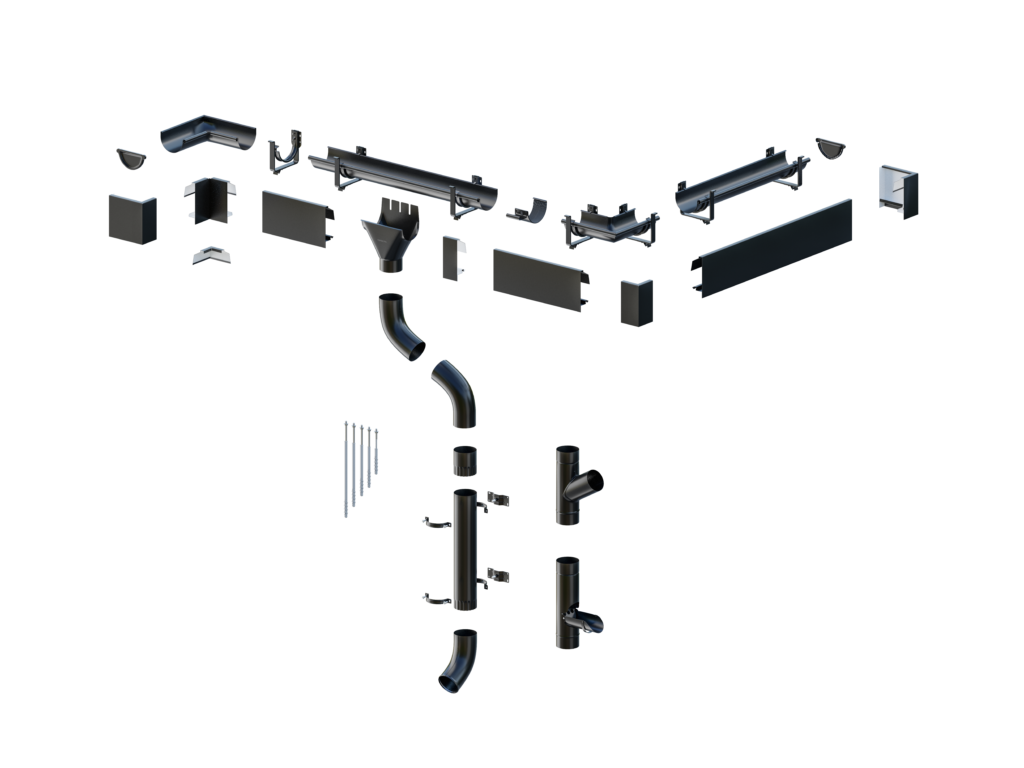
Gutters are horizontal components of a gutter system with an open cross-section that run along the edge of the roof. Their depth and diameter are selected based on the amount of rainwater they will carry away from the roof surface. This depends primarily on the size of the roof.
Gutters can have a round or square cross-section, making them suitable for various roof shapes.
Connectors are specially shaped fittings that allow gutters to be joined along straight sections. They are integrated with a sealing strip and a clamp, so they create a watertight connection between the gutters.
Corner pieces are used to connect gutters at the internal and external corners of a building, where the gutters change direction. They typically form a right angle, but 135-degree corner pieces are also available on the market, and custom solutions can be manufactured upon request.
End caps are finishing details that close off the gutter system at the end of each level.
Steel hooks serve as gutter brackets, ensuring that the gutters are securely fastened along the edge of the roof. Depending on the method of gutter installation, they can be rafter-mounted or end-mounted; there are also combi hooks that can be screwed in place without removing the existing roof coverings. Due to snow loads, the expansion of the gutter system, and the need to ensure the required gutter slope, it is important to space the gutter hooks correctly.
These are vertical sections of pipe with a closed cross-section that are used to drain rainwater downward from the gutters. They are most often installed at the outer corners of a building’s walls, though this is not always the case. The number and location of drain pipes depend on the size and shape of the roof.
Pipes, like gutters, can have a round or square cross-section. Pipes should be installed using downpipe brackets. Decorative chains or spouts are sometimes used instead of drain pipes.
It is used to connect drain pipes.
This is a component used for assembly of drain pipes on the walls of a building. The clamps are screwed onto special metal plates that are also part of the system.
An outlet is a component that allows a drain pipe to be connected to a gutter system. Its shape is designed to fit a specific gutter model.
In addition to the main components, the gutter system also includes a number of additional elements:
It is needed on roofs with an overhang, where the drain pipes are not aligned with the gutters but are set back from them.
A vertical component of the drainage system used to extend drain pipes that no longer have their original ends after being cut.
It allows two drain pipes to be connected to a single drain. T-connections are used to connect pipes of different diameters.
It allows you to inspect the drain pipe, and thanks to a special hinged section, it can also be used to divert rainwater to an outdoor tank for use in the garden. For this reason, it is also called a rainwater catcher.
Spouts are installed at the ends of drain pipes that are not buried in the ground. They allow water to be drained into the storm sewer system.
It serves as a finishing element of the gutter system. It conceals round gutters and corners, enhancing the system’s appearance. The cover system also includes a set of matching connectors and fasteners.
When assembling a gutter system, additional products such as touch-up paint for minor damage, screws for downpipe brackets, or roofing sealants may come in handy.
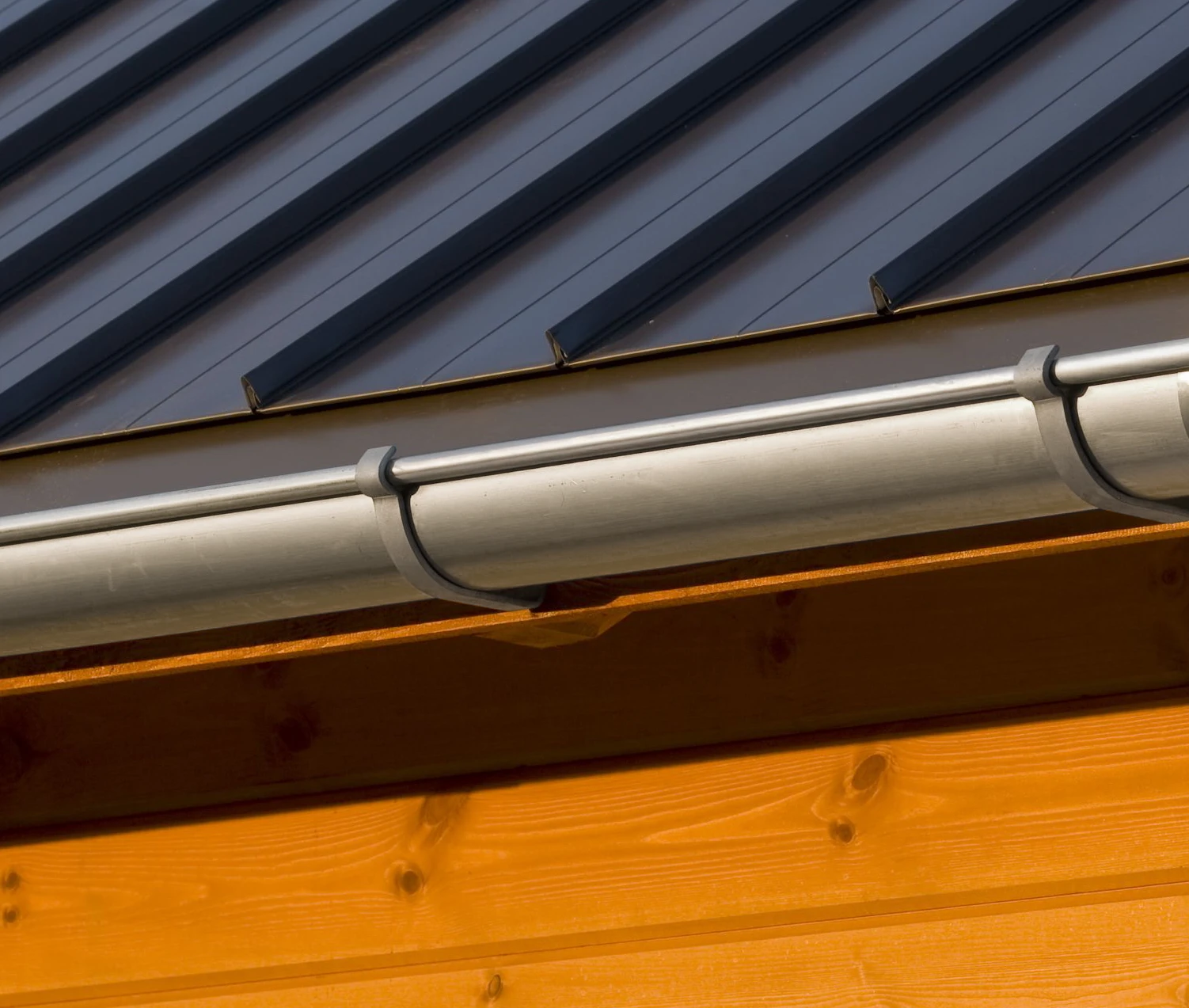

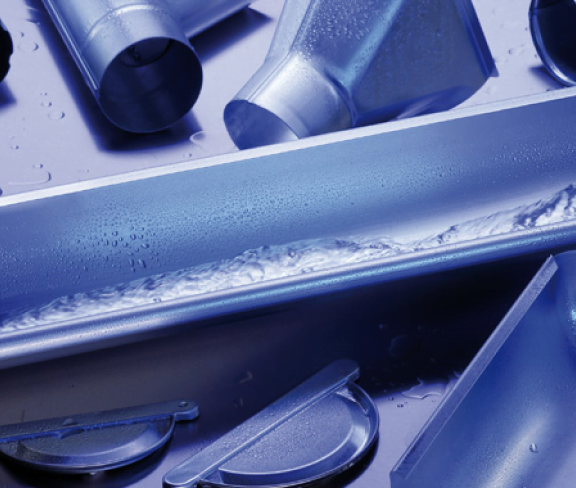
PVC gutters are the cheapest, but also the least durable . Metal gutters are much more resistant to mechanical damage, corrosion, and discoloration . There are several types of sheet metal gutter systems.
Copper gutters are a niche product and very expensive, though they are certainly the most durable .
Coated steel systems are the most popular , with those featuring polyurethane coatings being the highest quality. They offer excellent color stability and are highly resistant to corrosion. A less expensive yet equally durable option is galvanized steel gutters without a protective or decorativecoating.
Titanium-zinc systems— made of a zinc alloy with added titanium, copper, and aluminum — are characterized by their exceptionally high durability. Over time, their surface develops a patina and becomes matte, providing natural corrosion protection for the metal core. Titanium also provides high resistance to acid rain.
Our exclusive product is a titanium-aluminum gutter made from an alloy of aluminum, titanium, molybdenum, manganese, and chromium. These components, which are naturally coated with aluminum oxide, are extremely resistant to corrosion and salt damage, making them ideal even in harsh environments, such as polluted or coastal areas. Gutters made from this material are also highly resistant to damage and bending, while remaining lightweight.
Znalezienie rzetelnej ekipy budowlanej jest sporym wyzwaniem. Warto za poszukiwania zabrać się minimum 2-3 miesiące przed […]
Read moreJak czyścić blachodachówkę Blachodachówka na dachach polskich domów jest spotykana najczęściej. Inwestorzy doceniają jej wysoką jakość, […]
Read moreWymiana starego pokrycia dachowego – na co warto zwrócić uwagę? Wymiana starego pokrycia to nie tylko […]
Read more