- Offer
Products
Additional services and products
- Download
- Good to know
- Training
- Promotional program
- Inspirations
- About company
- Szukaj
- Contact us
- EN
MENU
The price of standing-seam panels is one of the first questions that comes up when planning a new roof or a roof renovation. Standing-seam panels are particularly popular in modern architecture, where simple form, clean lines, and hidden fasteners are key.
How much will standing-seam metal roofing cost in 2026? In the current price list, prices start at 59.90 PLN (gross) per total square meter. Depending on the type of coating, the price can rise to 93.79 PLN gross per m², while the 0.70 mm-thick sheet metal option costs 115.12 PLN gross per m². What accounts for such large differences? Primarily, they result from the type of coating used and the thickness of the steel core. The total cost of the roof is also influenced by flashings, accessories, transportation, and assembly.
In this post, you’ll learn:
The price depends primarily on the type of coating and the thickness of the steel core. The standard option is 0.50 mm-thick sheet metal, but panels made of 0.70 mm-thick sheet metal are also available .
Coating type / variant | Price April 2025 | Price June 2026 | Increase |
Polyester Gloss | 53,83 zł | 59,90 zł | +11,3% |
ULTRAMAT | 58,69 zł | 65,31 zł | +11,3% |
TOPMAT | no data | 67,28 zł | – |
PURLAK | 81,33 zł | 90,47 zł | +11,2% |
PURMAT | 84,32 zł | 93,79 zł | +11,2% |
Polyester Gloss, gr. 0,70 mm | 111,80 zł | 115,12 zł | +3,0% |
The values listed are gross prices per total square meter. This is important because the statement “a standing-seam panel costs about 60 zł/m²” doesn’t tell us much on its own. The price depends on which product we’re comparing. The price will differ for a basic polyester coating, a coating with higher protective properties, and a panel made of thicker sheet metal.
Compared to April 2025, prices for the basic variants rose by approximately 11%. For Poliester Połysk, the increase was 11.3%, similar to that for ULTRAMAT. The PURLAK and PURMAT variants rose in price by 11.2% each. A smaller change was observed for 0.70 mm-thick sheet metal—here, the increase was approximately 3%. When comparing year-over-year data, however, it is important to remember that a price change for a specific variant does not automatically mean the same change for all panels. The price is influenced by the parameters of the selected solution.
When it comes to the panel itself, two factors are most important: the type of coating and the thickness of the steel core. This is where most of the price differences between the various options stem from.
A coating does not serve merely an aesthetic purpose. Its primary function is to protect the steel core from external factors. Different coatings vary in their properties and resistance to, among other things , UV radiation, corrosion, moisture, weather conditions, and surface damage. This is important both for the coating’s durability and for maintaining its appearance over the years of use. Therefore, when we pay for a more advanced coating, we are not only paying for its appearance but, above all, for its superior protective properties and greater resistance to external factors. The PURMAT coating is a good example. On the PD510 panel, it is 50 µm thick, provides high resistance to corrosion and UV radiation, and the product covered by it may be eligible for a technical Warranty of up to 50 years. It is therefore advisable to base your choice of coating on the conditions under which the roof will be used, the expected service life, and the investment budget. The most expensive coating is not always necessary. However, when comparing offers, it is important to verify that they pertain to the same type of finish and similar specifications. More information about standing seam panels and their properties can be found in this article.
A thicker steel core means greater panel rigidity and greater resistance to deformation. However, this does not mean that 0.70 mm-thick sheet metal must be used on every roof. For standing-seam panels , 0.50 mm is the standard thickness and is sufficient for typical applications. Increasing the thickness should be based on specific technical justification. This is particularly important for panels with a flat profile. With this type of surface, waviness may occur due to the nature of the material. Using 0.70 mm thick sheet metal helps minimize this phenomenon. A 0.70 mm sheet may also be justified when the roof design requires greater stiffness of the roofing material. However, one should not follow the rule that “the thicker the sheet, the better.” If the additional thickness does not provide a specific technical benefit, its use may simply be economically unjustified. The price difference illustrates why the choice of thickness should be carefully considered. When making a purchase, it is therefore advisable to match the sheet thickness to the type of panel, the profiling method, and the specific requirements of the roof, rather than automatically choosing the thickest option.
The price per square meter of the panel is just the starting point for the calculation. The cost of the entire roof also includes the components needed to install a complete roof system. Depending on the project, you’ll need to take into account, among other things:
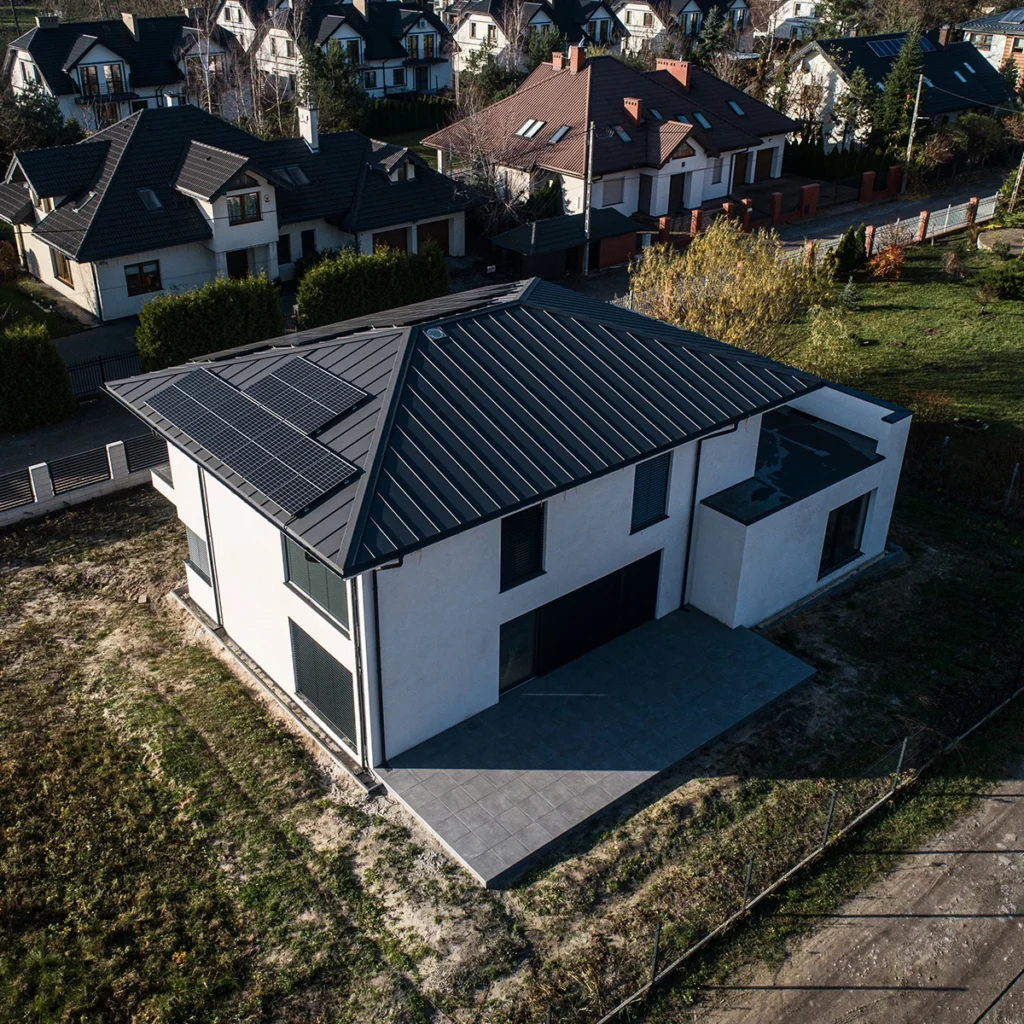
The shape of the roof is also very important. On a simple, flat roof, the number of flashings and additional work will be lower than on a multi-sloped roof with valleys, chimneys, roof windows, or numerous breaks in the roofline. Therefore, the answer to the question “How much does a standing-seam roof cost?” must take into account the specific design. The price per square meter of the panel itself is a good starting point, but it does not replace a full estimate.
The price of the panels is not the only cost associated with building a roof. Labor also accounts for a significant portion of the investment. Assembly of standing seam panels requires experience and knowledge of the specifics of this type of roofing. The contractor must properly lay out the panels, secure and join them, and prepare the flashings at the eaves, ridge, roof edges, and other roof elements. For this reason, assembly of standing seam panels may cost more than assembly of simpler roof coverings. The higher rate charged by an experienced crew stems not only from the time required but also from the knowledge and expertise needed to install the roof coverings correctly. The labor cost is also influenced by the shape and complexity of the roof, the number of flashings, the number of elements penetrating the roof surface, and the region where the work is being carried out. The more complex the roof, the more work the contractor must do. Therefore, when comparing quotes, it’s worth checking not only the price of the panels but also the exact scope of assembly.
Noise caused by rain or hail can be particularly significant in the case of converted attics. One solution for reducing noise is VENTSOL Akustic soundproofing tape, applied to the underside of the panels. It reduces noise levels by 4–6 dB. The product is designed, among other things, for PD510 standing seam panels and can be used with various types of seams. The tape measures 5 × 100 mm, and one roll contains 20 m of material. In the current price list, it costs 4.31 PLN (gross) per running meter. By comparison, a soundproofing mat costs 10.14 PLN (gross) per running meter. It is worth considering the use of additional soundproofing, especially when the panels are located above living spaces and acoustic comfort is an important factor in the use of the attic.
Yes. A photovoltaic system can be installed on a roof using interlocking panels and appropriate brackets attached to the roof seam. In the current price list, photovoltaic roof ridge brackets cost 70.11–84.87 PLN gross per piece, depending on the finish. They are made of A2 stainless steel, and the set includes two 6.5 × 55 mm screws. When estimating installation costs, keep in mind that the number of brackets depends on the mounting system’s design and the layout of the modules.
Steel changes its dimensions under the influence of temperature—it expands as the temperature rises and contracts as it cools. This phenomenon must be taken into account when designing and performing assembly of the roofing, especially in the case of long panels. Above all, the proper method of fastening the panels and the ability to allow for controlled longitudinal movement are crucial. Proper assembly helps minimize the development of excessive stresses in the roofing system. The appearance and rigidity of the panel are also influenced by its profiling. In the case of a flat surface, due to the nature of the material, surface waviness may occur. Using 0.70 mm thick sheet metal helps minimize this phenomenon. Therefore, when selecting panels, it is important to consider not only their thickness but also the type of profiling, panel length, and assembly method. In typical applications, a thickness of 0.50 mm is the standard choice, while selecting 0.70 mm should be based on a specific technical solution.
The price of the panels is only one part of the cost estimate. The current price list, effective September 1, 2026, shows that accessories can also account for a significant portion of the total investment.
Key examples:
Accessory | Gross price |
Snow protection set for standing seam panels 240 cm | 790,89 zł |
Snow protection set for standing seam panels 360 cm | 1094,70 zł |
Pipe bracket for standing seam panels | 1094,70 zł82,41 zł/szt. 82,41 zł/szt. |
Photovoltaic bracket for standing seam | 70,11–84,87 zł/szt. |
Roof communication set for panels 60 cm | 396,06 zł |
Roof communication set for panels 120 cm | 638,37 zł |
Steel roof-ladder | 71,34–430,50 zł |
Standing seam roof-ladder bracket | 46,74 zł/szt. |
VENTSOL membranes, roll 75 m² | 344,40–1623,60 zł |
VENTSOL Acoustic Tape | 4,31 zł/m |
Sound-damping mat | 10,14 zł/m |
A snow guard kit for standing-seam panels currently costs between 790.89 PLN and 1,094.70 PLN, depending on the length of the kit. For roof access systems for standing seam panels , prices range from 396.06 to 638.37 PLN, depending on the length of the set. Various versions of VENTSOL membranes are also available. A roll with a surface area of 75 m² costs from 344.40 PLN for the STANDARD 135g version to 1,623.60 PLN for the MASTER 220g 2FIX version. VENTSOL PREMIUM 170g costs 430.50 PLN (gross) per roll. Not all accessories will be needed on every roof. Their selection depends on the design, the building’s structure, and its features.
When comparing quotes, it’s important to consider not only the price per square meter, but also the full scope of the project.
The key points are:
The best way to compare quotes, therefore, is to calculate the total cost of building the roof, rather than just the price per square meter.
After selecting the type of panel, coating, and sheet metal thickness, it’s a good idea to get a quote for your specific roof. This will help you determine the amount of material needed and choose the right flashings and accessories. Find your nearest retail location Blachy Pruszyński Company and ask for a quote on standing-seam panels along with the necessary accessories.
The price of standing-seam panels in 2026 depends primarily on the type of coating and the thickness of the steel core. In the current price list, prices start at 59.90 PLN gross per m² total and, depending on the selected option , can reach 115.12 PLN/m². More expensive coatings cost more primarily due to their superior protective properties, such as resistance to UV rays, corrosion, and weather conditions. Thicker sheet metal provides greater rigidity and resistance to deformation, but a thickness of 0.70 mm is not necessary for every roof. In typical applications, the standard thickness of 0.50 mm is sufficient. Thicker material is worth considering primarily when the profiling method or specific technical requirements of the roof call for it. The final cost of the project is also influenced by flashings, accessories, transportation, and assembly. For standing seam panels, it’s important to factor in the cost of an experienced installation team, and for buildings with a habitable attic, acoustic considerations should also be taken into account. A well-prepared estimate should therefore answer not only the question “How much does a standing seam panel cost?”, but above all , “How much will a complete standing seam roof for my building cost?”
That’s fine. Assembly requires experience and knowledge of the specific characteristics of this type of roofing, so an experienced crew may charge a higher rate than a contractor who works with simpler types of roofing.
Yes. This is the standard thickness used in typical applications. A 0.70 mm sheet may be required in certain applications, such as when forming a flat panel.
Greater thickness increases the panel’s rigidity and resistance to deformation. However, this does not mean that a thickness of 0.70 mm is necessary for every roof.
Yes. Brackets that attach to the seamed lock are used for assembly. According to the current price list, they cost 70.11–84.87 PLN (gross) per piece.
Acoustic solutions can be used in buildings with a usable attic. VENTSOL Akustic tape or Sound Control nonwoven fabric can reduce noise by 4–6 dB.
Znalezienie rzetelnej ekipy budowlanej jest sporym wyzwaniem. Warto za poszukiwania zabrać się minimum 2-3 miesiące przed […]
Read moreJak czyścić blachodachówkę Blachodachówka na dachach polskich domów jest spotykana najczęściej. Inwestorzy doceniają jej wysoką jakość, […]
Read moreWymiana starego pokrycia dachowego – na co warto zwrócić uwagę? Wymiana starego pokrycia to nie tylko […]
Read more