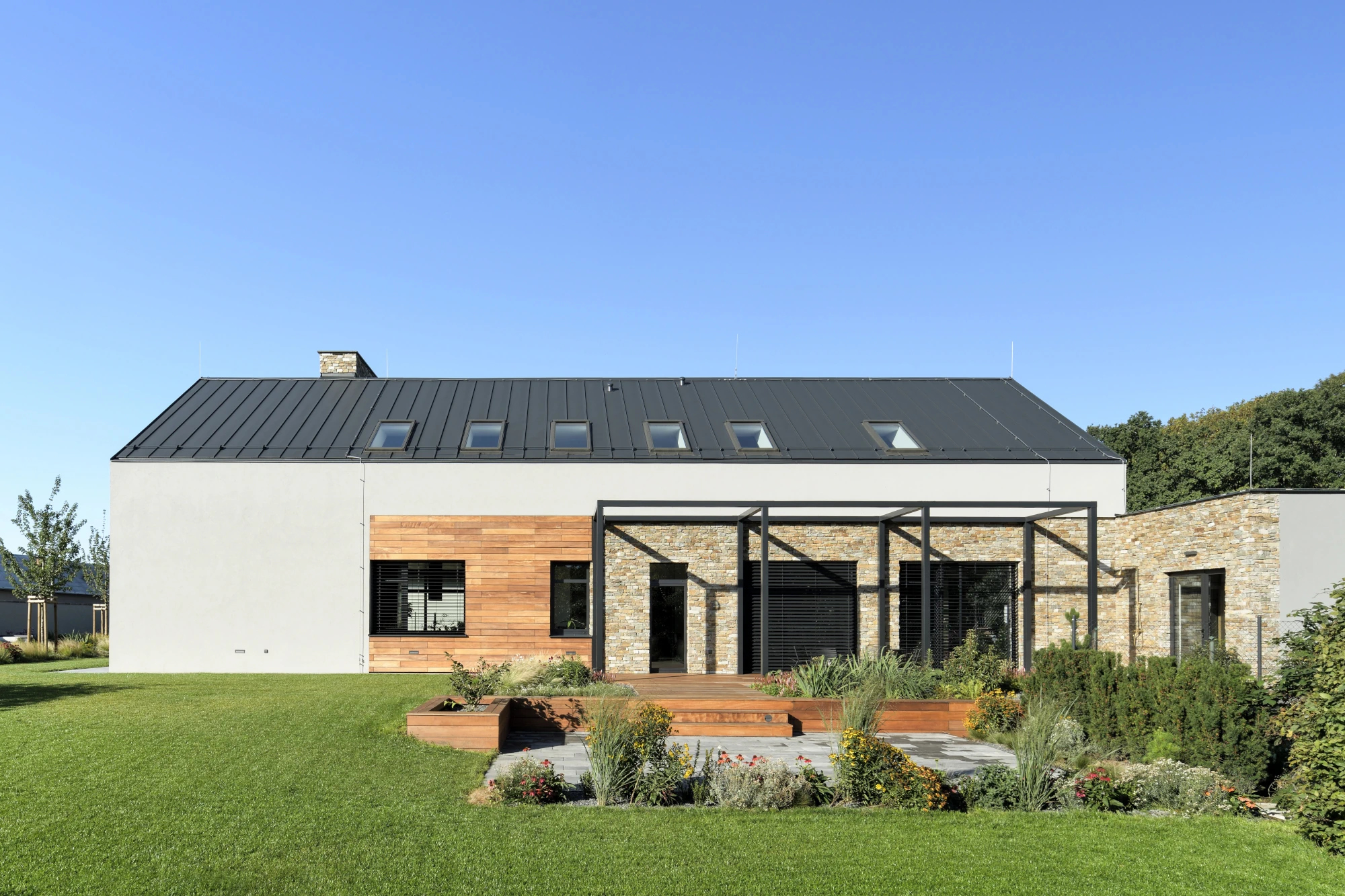
Modern architecture very often forgoes traditional eaves in favor of minimalism. A roof without eaves is a solution that, thanks to its form, emphasizes the clean lines of the geometric structure. By allowing for a seamless connection between wall insulation and the roof surface, a roof without eaves helps improve the building’s energy efficiency. However, this type of roof requires absolute precision, as errors in the installation of the concealed drainage system can lead to dangerous moisture penetration into the masonry structure.
In this post, you’ll learn about the most common problems:
In a series of articles, we’d like to introduce you to the specifics of roof construction—its physics, essential elements, key components, and the most common types of roofs found in Poland. The series,titled “The Ins and Outs of Roofs,”will consist of separate, standalone posts, all aimed at familiarizing our customers with the topic of roofs. These posts are created in collaboration with our experts, professionals, and master roofers—who have been working in the field for many years—and are based on educational materials published by the Polish Roofers’ Association (PSD). If you are interested in learning more about this topic, we encourage you to contact the PSD and Roofing Training Centers directly, as well as to review the publications issued by the PSD.
In this article, you’ll learn what a eave-less roof is and why it’s becoming increasingly common in modern single-family and commercial architecture. The absence of a traditional eave overhang gives the building’s form a minimalist, “clean” look, but at the same time requires a much more precise approach to structural details and drainage. This type of roof relies on the seamless integration of the roof surface with the facade and the use of concealed gutter systems, which must effectively drain water without the risk of moisture penetration into the walls. In this article, you’ll find an explanation of how this design works, where it works best, what energy and aesthetic benefits it offers, as well as its limitations and what to pay special attention to during design and installation to avoid costly construction errors.
Roofs without eaves are structures in which the roof surface ends flush with the line of the building’s exterior walls, without the rafters extending beyond the building’s outline. In traditional designs, the eaves protect the area beneath the gutter, whereas here the edge of the roof blends seamlessly with the facade. The secret to this design lies in the relocation of the drainage system— the gutters and downspouts are integrated into the building’s structure and concealed within a layer of thermal insulation or in a specially designed cornice. As a result, the building achieves a perfectly cohesive form, and its modern appearance catches the eye with its austere, minimalist design.
The main difference lies in the design of the eaves and the way insulation and drainage are routed. In a traditional gable roof, the projecting rafters intersect the line where the roof meets the wall. This forces the team installing the facade insulation to laboriously cut the insulation boards around each wooden beam, which creates a risk of leaks. A roof without an eave ends at the wall line, allowing for the creation of a continuous, smooth layer of insulation without so-called linear thermal bridges at the junction of the wall and the roof.
Another difference is the effect on interior lighting. A classic, wide eave acts as a natural canopy that casts a shadow over the windows of the attic and upper floors, limiting the amount of sunlight—especially in winter, when the sun is low in the sky. The absence of a roof overhang allows significantly more natural light to enter the interior, which ensures better sunlight exposure for the building and allows for maximum use of large glazed areas.
The final difference lies in aesthetics and drainage: a traditional overhanging roof stands out visually from the building and has external gutters, whereas a roof without an overhang forms a monolithic whole with the facade, featuring a concealed rainwater drainage system, which completely transforms the building’s appearance.
This type of roof is primarily used in modern designs built to passive house standards and in energy-efficient buildings with a simple, monolithic form (e.g., modern barns). A roof without an overhang is also a technical necessity for houses built directly on the property line. The building’s structure must not encroach in any way on the space above the neighboring lot; therefore, completely eliminating the overhanging eaves allows for a safe and legally compliant finish to the edge of the building’s structure, precisely along the property line.
Architects also choose this modern solution because of the building’s energy balance. A traditional, wide roof overhang limits the amount of sunlight entering the interior. Removing it allows for maximum use of large, south-facing windows. In winter, when the sun is low on the horizon, its rays enter the rooms unobstructed, helping to passively heat them. A roof without an overhang is therefore ideal wherever a minimalist aesthetic, combined with the optimization of heat gains, is a priority.

The proper construction of a roof without eaves relies on creating an integrated system in which the precise connection between the roof and the building’s walls is of paramount importance. Work begins with the roof truss—the ends of the rafters are specially cut or set back from the edges of the load-bearing walls to create space above the wall for installing drainage components and the selected roofing material.
The next step is to prepare the drainage system. At the junction of the roof and the wall, in a prepared recess, dedicated cornices or gutter brackets are installed, into which concealed gutters are mounted. In the facade insulation layer, the insulation team cuts vertical grooves—it is in these recesses that the downspouts carrying rainwater are concealed.
The final piece of the puzzle is a watertight seal along the edges. The lower edge of the roof is finished with specially contoured strips installed below and above the gutter, as well as system-specific covers that completely conceal the gutter, aligning it with the plane of the facade. A key requirement for the effectiveness of this system is maintaining the continuity of the insulation: the exterior wall insulation must connect seamlessly to the roof’s thermal insulation, which permanently eliminates linear thermal bridges in the cornice area.
Why choose a roof without an eave? Its main advantage is high energy efficiency. By eliminating traditional, protruding rafters, the insulation team can maintain perfect continuity of the insulation at the junction of the wall and roof, which effectively minimizes the risk of linear thermal bridges.
Investors also choose this solution for its aesthetic appeal—it creates a minimalist, modern look that fits perfectly with current trends. Additionally, completely removing the overhang above the windows allows for maximum natural light to enter the rooms.
Every solution has its pros and cons—and the same is true for a roof without eaves. The main drawback of a roof without eaves is that the facade is directly exposed to driving rain. The lack of overhanging roof slopes means that the building’s walls and windows receive less protection from precipitation, which—in the event of construction errors or the absence of proper flashing—can lead to unsightly water stains. Additionally, the lack of an eave deprives the building of natural shade in the summer —without the use of external roller shades or facade blinds, intense sunlight can cause rooms to overheat.
From a construction standpoint, the greatest risk is a failure of the concealed drainage system. Downspouts and gutters are concealed within the insulation layer, so any leak in the system poses a direct risk of moisture penetration into the thermal insulation and the structural walls themselves. Inadequate air circulation around these components can also lead to faster deterioration of the insulation materials. This challenge takes on enormous significance in energy-efficient homes. For this reason, this system requires the purchase of specialized, more expensive components and absolute precision from the installation team—there is no room for even the slightest error here.
Most problems associated with eave-less roofs do not stem from the design itself, but from construction flaws. A serious threat in our climate is water freezing in concealed gutters during the winter. The resulting ice blockage can cause joints to leak, leading to water damage to the building’s walls. For this reason, it should be standard practice to install heating cables in the gutters, along with additional safeguards that effectively protect the gutter system from the negative effects of low temperatures.
Another issue is the need for regular maintenance. Failure to clear leaves and pine needles from the gutters causes them to become clogged, resulting in accumulated rainwater overflowing directly into the facade’s insulation layer. Maintaining the continuity of the insulation is also a major challenge. Insulation wool or Styrofoam that is carelessly installed at the junction of the roof and wall creates thermal bridges that are difficult to eliminate. Additionally, improperly shaped metal flashings at the roof edge allow water to seep under the plaster, damaging the facade.
The key to the durability of a roof without eaves is the absolute watertightness of the drainage system. Water flowing down the roof surface enters a gutter set in a specially prepared recess. From there, the water flows down the building through vertical downspouts. These pipes are completely concealed within the wall’s thermal insulation layer—they are installed in grooves cut into the expanded polystyrene or mineral wool and then covered with exterior plaster, which completely hides the downspouts from view.
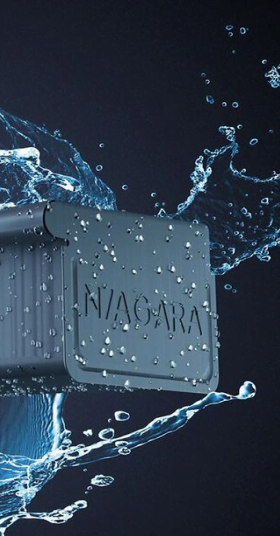
Tip! If you’re building a house with a simple design, check out the Niagara gutter systems from Blachy Pruszyński. The wide range of components allows for flexible adaptation of the system to the thickness of the insulation and the building’s design. Thanks to the use of high-quality coated steel and precisely fitted mounting components, this solution guarantees effective water drainage and long-lasting resistance to harsh weather conditions.
The choice of materials is crucial for ensuring the building’s watertightness and achieving a modern look. In contemporary architecture, flat sheet metal is the clear favorite, particularly standing-seam steel panels. They create a minimalist surface that harmonizes with a concealed gutter system. Importantly, the same panel can be extended from the roof surface directly onto the building’s facade, creating a cohesive form. Premium-grade materials (e.g., from Blachy Pruszyński) work best in such structures, as they guarantee extreme resistance to corrosion, UV radiation, and mechanical damage.
An alternative roofing material is flat ceramic or cement roof tiles, which create a geometric pattern on the roof that emphasizes the building’s modern, minimalist look.
Important! Regardless of the roofing material chosen, all accessories, fasteners, and structural components installed along the roof edges must offer the highest level of moisture resistance to ensure the structure’s durability and safety for many years to come.
When analyzing construction costs, it is important to keep in mind that a roof without an eave requires the use of specialized components. Although the roof truss structure itself (in the case of a simple roof design) is straightforward to install, the specialized flashings, cover plates, and integrated concealed drainage systems are more expensive than traditional solutions.
The average cost of materials ranges from 250 to 400 zł per m². On top of that, labor costs are higher, as roofers expect higher pay for installing a roof without eaves due to the stringent technical requirements. Rates for professional installation range from 150 to as much as 250 PLN per square meter. Ultimately , the total cost of building a roof without eaves is about 15–30% higher than that of a standard gable roof.
The most important technical decisions must be made during the design phase. The architect must precisely plan the routing of downspouts within the wall insulation, ensuring the insulation is of sufficient thickness. The documentation should account for the proper slope of the gutters and provide easy access for inspection of the entire system.
Proper ventilation of the roof deck is also extremely important—a roof without an eave must have unobstructed intake and exhaust vents to ensure the free flow of air beneath the roofing material. It is also essential to carefully mark the roof’s edge line so that water is directed straight into the gutter system without flooding the facade.
Remember! The design should address the issue of regular maintenance of the drainage system to ensure its reliable operation.
An analysis of the pros and cons shows that a roof without an eave is not a one-size-fits-all choice for every building. If the design calls for a classic structure (e.g., in the style of a manor house), a standard roof with an eave will work better.
For lovers of modern style and energy-efficient construction, a roof without eaves is the ideal solution. It creates a monolithic yet elegant look, making the building stand out spectacularly against its surroundings. However, it’s important to remember that this type of construction leaves no room for error and requires an experienced roofing crew. The decision should be made carefully, ensuring that the roof’s design aligns with both the architectural style and the budget.
Yes, a roof without eaves is usually more expensive to build. The higher cost stems from the need to use a specialized gutter system (gutters concealed within the facade), more precise flashing work, and the need to ensure excellent waterproofing at critical points where the roof meets the wall.
The greatest risk is improper drainage of rainwater, which can lead to moisture penetration in the facade and, in extreme cases, to its deterioration. Therefore, it is crucial to use proven concealed gutter systems and to hire a specialized roofing crew with experience in installing this type of structure.
Yes, concealed gutter systems require regular maintenance. Because the gutters are hidden inside the facade structure, it is harder to notice if they become clogged (e.g., with leaves or pine needles). It is recommended to clean the system at least once a year to avoid the risk of water overflow and damage to the building’s exterior finishes.
Although a roof without eaves is very aesthetically pleasing, special care must be taken in areas with exceptionally heavy snowfall or rainfall. Under such conditions, the drainage system must be designed with a higher capacity margin, and the flashings must be installed with the utmost care to eliminate the risk of water seeping under the roofing material.
Not in every case. The decision to choose a roof without eaves is best made either when selecting a pre-designed plan or during the design phase with an architect. This design requires proper planning of the roof ring beam, the building’s insulation, and the installation of gutters to prevent thermal bridges that could lead to heat loss or moisture condensation.
Panele dachowe na rąbek to połączenie nowoczesnego designu z wyjątkową funkcjonalnością. Elegancki wygląd, wysoka szczelność i […]
Read moreWybór odpowiedniego pokrycia dachowego to jedna z kluczowych decyzji przy budowie lub remoncie dachu. W ostatnich […]
Read moreBlaszane pokrycia dachowe są uniwersalne, łatwe w montażu i pasują do nowoczesnej architektury. Blacha trapezowa, blachodachówka […]
Read morePodstawą każdego dachu jest więźba dachowa. Standardowa konstrukcja wykonywana jest z drewna. Jednak drewniany szkielet dachu […]
Read moreDach mansardowy to jeden z najbardziej rozpoznawalnych typów dachów. Cieszy się dużą popularnością w europejskiej architekturze, […]
Read moreW architekturze domów jednorodzinnych często pojawią się dachy czterospadowe w różnych wariantach. Uważane są za reprezentacyjne […]
Read moreW nowoczesnym budownictwie dominuje minimalizm. I jak się okazuje, w tym nurcie doskonale odnajduje się tradycyjny […]
Read moreW budownictwie energooszczędnym dominują domy o mało skomplikowanej bryle na planie kwadratu czy prostokąta. W związku […]
Read more